
A Guide to Corporate Dystopias That Bite Back

Corporate dystopias.
The worst corporate dystopia does not begin with a skull-shaped logo or a CEO stroking a white cat. It begins with a useful app. A loyalty scheme. A workplace that says it is a family, then asks why you have not answered messages at 11.48 pm. This guide to corporate dystopias is for readers who enjoy the uncomfortable little shiver of recognising that the fictional nightmare is only two product updates away.
Corporate dystopian fiction turns capitalism's most polished promises into pressure points. Convenience becomes control. Personalisation becomes surveillance. Growth becomes a moral imperative so vast that actual people are reduced to a minor inconvenience in the quarterly report. It is the genre's particular party trick: making a glass-walled office, an attractive interface or a branded tote bag feel faintly menacing.
What makes a corporate dystopia different?
A corporate dystopia is not simply a story with a bad company in it. Plenty of thrillers have corrupt firms, dodgy experiments and a boardroom full of people who should absolutely not be left near the big red button. In a true corporate dystopia, the company does not merely cause trouble. It shapes the rules by which trouble can be understood.
The corporation might provide housing, healthcare, entertainment, food, security and employment until opting out is technically possible but practically ridiculous. Or it might own the systems that tell people what they want, whom they can trust and which version of reality counts. The point is not that business is evil. The point is that concentrated power gets very strange when it has a customer-service voice.
That is why these novels often sit so neatly beside speculative thrillers such as The Matrix, The Truman Show and Inception. All ask a version of the same unsettling question: if your reality has been designed for you, how would you know? Corporate dystopias add the extra insult that the answer may be hiding in the terms and conditions.
A guide to corporate dystopias: the essential ingredients
The genre works best when its nightmare is plausible enough to make readers glance suspiciously at their phones. Not every story needs every ingredient, but the strongest ones tend to combine a few of the following pressures.
The benevolent brand
The corporation usually has a gorgeous public face. It speaks warmly about community, innovation, wellbeing or making the world better. Its adverts have sunlit kitchens, diverse friendship groups and a font that says, ‘We would never manipulate you.’
Behind that polish sits a harder logic. The company must grow. It must acquire data, territory, loyalty or influence. Individual damage can be regrettable, but it cannot be allowed to interrupt the mission. A villain who cackles is simple. A company that issues a sincere apology while continuing exactly as before is much more fun, and much more chilling.
The engineered choice
Corporate dystopias are rarely interested in obvious chains. They are interested in choices that arrive pre-selected. You can leave, of course, but you lose your job, your social score, your medication, your flat or your access to everyone you know. You can disagree, but the platform may quietly stop showing your messages.
This is where the genre becomes philosophical rather than merely cynical. What counts as free will when every option has been arranged by an institution that knows you better than you know yourself? A character may make a decision willingly, only to discover that willingness was the product being sold.
The perfect system with a human-shaped flaw
A corporate regime often promises efficiency. No waste. No uncertainty. No difficult, gloriously inconvenient human mess. But people are not spreadsheets, and the flaw in the system is usually its inability to account for grief, desire, loyalty, intuition or the stubborn urge to do something that makes no commercial sense.
That gives these stories their emotional pulse. The protagonist is not always a born rebel in a leather jacket. They may be an employee who believed in the mission, a customer who loved the service, or a person who simply wanted their life to work. The betrayal hits harder when the dream was genuinely appealing.
Language that tidies away the horror
Listen to the euphemisms. ‘Optimisation’ may mean replacing workers. ‘Safety’ may mean permanent monitoring. ‘User experience’ may mean making dissent inconvenient. Great corporate dystopias understand that language does not just describe power. It helps power look presentable.
This is also why the genre can be very funny. Nothing says menace quite like an internal memo announcing that involuntary memory deletion will improve team wellbeing. Satire gives the reader space to laugh, then makes them regret laughing a bit. Ideal.
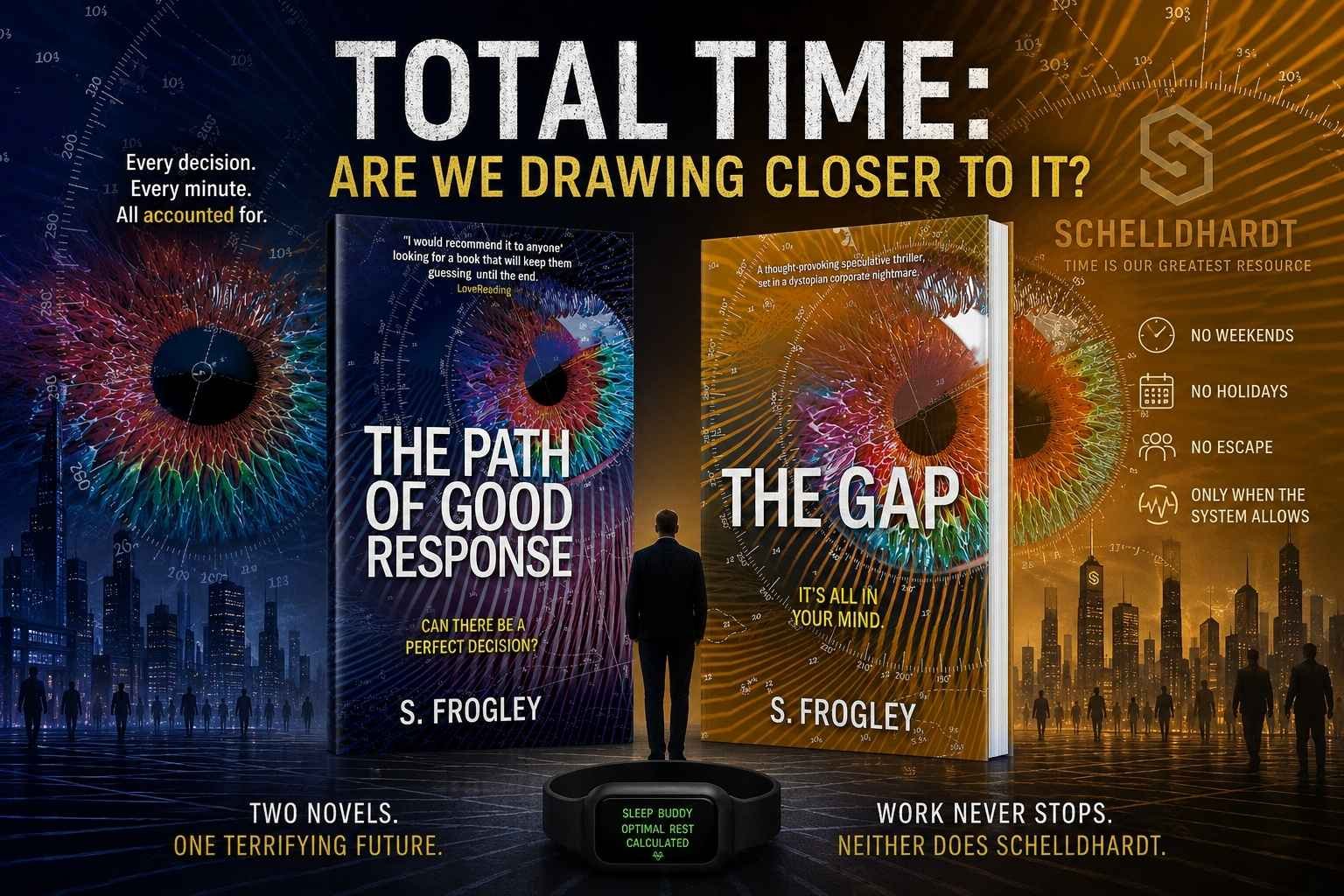
The Schelldhardt series. Two separate corporate dystopia stories in the same universe.
Why corporate dystopias feel especially close now
Every era has imagined the institutions it fears. Earlier dystopias often fixated on the state, war or blunt authoritarian control. Contemporary corporate dystopias are more likely to worry about the systems we invite into our homes because they save us time, recommend a decent programme and remember which oat milk we buy.
The fear is not necessarily that technology itself is wicked. It is that convenience can make scrutiny feel exhausting. If a platform gives you everything, questioning it can seem fussy. If a company creates jobs, culture and connection, criticism can be framed as negativity. The genre pokes at that soft spot: our understandable wish for life to be easier.
There is an anti-globalisation current here, too. The fictional corporation expands because expansion is treated as proof of virtue. Local quirks, competing ideas and inconvenient borders are obstacles to be smoothed away. The result may look frictionless, but friction is often where difference survives.
For readers, that makes corporate dystopias more than a parade of ominous logos. They are stories about scale. What happens when an organisation becomes too large to see the people it affects, yet intimate enough to influence their private thoughts?
The tension that keeps the pages turning
The best examples do not preach from a safe distance. They make the corporate offer tempting. Perhaps the company has made illness manageable, loneliness rarer or work more secure. Perhaps its immersive product is genuinely extraordinary. Perhaps the supposedly perfect decision really would save someone you love.
That ambiguity matters. A story where every employee is foolish and every consumer is hypnotised has nowhere interesting to go. Readers want to feel the seduction. They want to understand why intelligent people sign up, stay quiet and defend a system that harms them. The scariest dystopia is not the one no one would choose. It is the one you might choose on a difficult Tuesday.
This is a useful test when picking your next read. Look for a premise that has an emotional cost, not just a clever concept. A corporation controlling dreams is intriguing; a corporation controlling dreams because grief-stricken customers cannot bear to wake up is a story. The speculative machinery should sharpen the human dilemma, not replace it.
Where to start if you like reality with a glitch
If your taste runs towards stories where the world is fractionally off-kilter, seek out corporate dystopias that keep their rules clear while letting certainty fray. You may prefer the paranoid thriller version, where a character uncovers a conspiracy and cannot tell who is watching. Or you may prefer the slower, stranger version, where the company has normalised something so bizarre that rebellion begins with noticing it.
Heptagon Books' The Gap sits comfortably in that second, reality-questioning mood: the kind of speculative fiction that asks readers to examine the choices placed before them, and who benefits when those choices appear perfect.
Do not worry too much about whether a book is labelled dystopian, speculative, techno-thriller or literary weirdness. Modern genre shelves are a bit like office restructures: the categories keep changing, but everybody is still expected to know where they belong. Follow the feeling instead. You are looking for unease with ideas behind it, a plot with momentum, and a premise that makes ordinary life look newly suspicious.
Read the fine print, then enjoy the panic
Corporate dystopias endure because they understand a very modern fear: not that we will be forced into a worse world, but that we will be persuaded, rewarded and gently nudged into building it ourselves. They are thrilling precisely because they leave room for resistance, however small.
So choose the book with the too-perfect company, the cheerful tagline and the suspiciously generous employee benefits. Then keep an eye on the character who asks the question everyone else has learned not to ask. They may not save the world, but they will make it harder for the world to keep pretending it is fine.
