
Speculative Fiction Trends Worth Watching Now
Speculative fiction trends
The most interesting speculative fiction trends are not asking whether technology might change our lives. They are asking who gets to press the button, who writes the terms and conditions, and why the supposedly perfect system feels faintly like a hostage situation. If you like The Matrix, Inception or The Truman Show, this is very much your reading era.
The genre is moving away from shiny gadget worship and towards something more intimate, unnerving and emotionally exact. The nightmare is no longer a distant robot uprising. It is an app that knows you better than your best friend, an employer that can edit your memories, or a corporation offering to solve your loneliness for one small, non-refundable sacrifice.
For readers who enjoy a thriller with a philosophical itch beneath it, that is excellent news. Here are the currents shaping speculative fiction right now - and why they are landing so hard.
Speculative Fiction Trends: Reality Is Under Review
The biggest shift is the return of reality-bending premises with human stakes. Readers still want the high-concept question: what if the world is a simulation, a controlled experiment or a carefully managed lie? But they are less impressed by a twist that exists simply to make them fling the book across the room at 1am.
The strongest stories make unreality personal. A character may discover that their life has been designed by someone else, but the real tension lies in what that discovery does to their relationships, their sense of guilt and their idea of free will. Was the love real? Does a choice count if it was predicted? Can a person be morally responsible in a world built to steer them?
That is why the old touchstones keep circulating in reader conversations. The Truman Show is not only memorable because its premise is brilliantly cruel; it works because Truman’s escape is an act of emotional selfhood. Inception makes us care about layers of dream logic because grief is waiting at the centre of them. The concept gets readers through the door. The ache makes them stay.
Expect more books in which the familiar turns a degree strange: a neighbourhood with rules nobody questions, a workplace that has become a complete belief system, a wellness programme that seems to know rather too much. The best of these feel plausible enough to make checking your smart speaker’s little light seem, briefly, entirely reasonable.
The Corporation Is the Monster Again
Corporate dystopia is back with its name badge on, its calming brand palette and a quarterly growth target that may require the end of independent thought.
This is not a return to cartoonish evil tycoons stroking a cat in a glass tower. Contemporary speculative fiction is more interested in systems that sound useful. The company might promise efficiency, safety, health, connection or a better decision-making process. Its employees may genuinely believe in the mission. That is what makes the power struggle stick.
Readers are alert to the language of optimisation because they hear it everywhere. We are constantly invited to measure ourselves, improve ourselves, monetise ourselves and accept a personalised recommendation from an entity that insists it only wants what is best for us. Fiction has noticed the creepiness of this arrangement. Politely, of course. There will be a feedback form.
The anti-globalisation thread matters here, too. In many new speculative thrillers, the threat is not merely a villainous firm with too much money. It is the flattening effect of a system that wants every city, person and culture to function in one profitable way. Local quirks become inefficiencies. Privacy becomes friction. Doubt becomes a customer-service issue.
That gives writers a rich source of conflict. The protagonist is often not fighting a monster they can defeat with a single dramatic speech. They are fighting a machine that has made itself convenient. There is no easy escape when the thing controlling your life also delivers your food, pays your wage and offers a reassuringly tidy solution to your problems.
Near-Future Beats Far-Future, Most of the Time
Far-future space operas will always have their devotees, as they should. Sometimes you need an impossible planet, a morally complicated alien and a ship with a name that deserves its own fan account. But the near future has a special charge at the moment.
A setting five minutes ahead of our own allows writers to use recognition as a weapon. The technology need not be dazzlingly advanced. It only has to be one step beyond something readers already tolerate: predictive software, immersive entertainment, biometric surveillance, automated decision-making or an online identity that carries more authority than the person attached to it.
This closeness makes a speculative thriller feel less like a warning from another galaxy and more like an alarming message from your future self. The question is not, “Could this ever happen?” It is, “How did we let this become normal?”
There is a trade-off, though. Near-future fiction cannot simply paste a slightly sinister app onto present-day life and call it prophecy. Readers are tech-literate. They can smell a vague algorithm from several chapters away. The imagined system needs rules, limits and consequences. Better still, it needs to expose something that already exists in miniature.
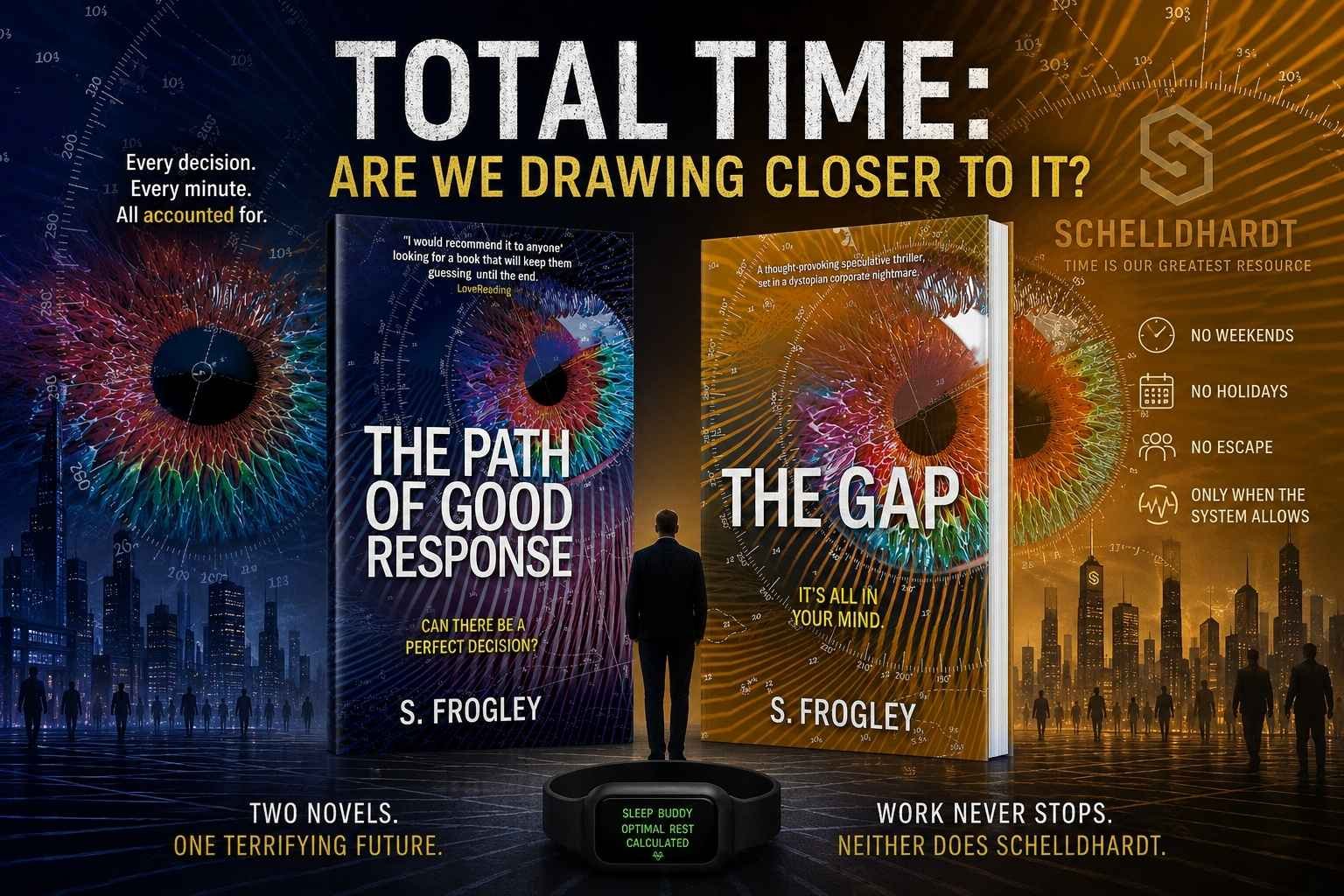
The Schelldhardt Series. Speculative thrillers with a twist.
The Perfect Decision Is a Terrifying Premise
One of the sharpest speculative fiction trends centres on the fantasy of certainty. What if a system could tell you the right thing to do? Not just which route avoids traffic, but whom to love, whether to forgive, when to leave, which life will produce the least regret.
At first glance, that sounds soothing. No more 2am spirals. No more staring at a text message and consulting three friends, a group chat and a tarot reader. Yet a story becomes interesting at precisely the point where certainty starts to cost something.
A perfect decision-maker challenges a deeply held idea: that being human means choosing under pressure, with incomplete information, and then living with the consequences. If an algorithm can calculate the optimal moral act, does compassion become redundant? If it can predict our choices, are we free? And if following it harms someone we love, who is accountable?
These novels work best when they resist an easy answer. The machine should not be obviously wrong from page one, and the human alternative should not be automatically noble. There is real dramatic voltage in a system that is helpful nine times out of ten. The tenth time is where the book lives.
Intimate Stakes Are Giving Big Ideas a Pulse
For all the interest in surveillance, simulated reality and corporate overreach, contemporary speculative fiction is becoming more emotionally grounded, not less. A grand premise has greater impact when it lands in a kitchen, a friendship, a marriage or a family secret.
That does not mean every book needs a romance plot, though a compelling relationship can raise the temperature of any thriller. It means the stakes need a face. Saving humanity is broad. Saving the person who knows who you were before the world rewrote you is specific.
This is also where genre-blending earns its keep. Speculative fiction is borrowing the forward momentum of thrillers, the emotional attention of relationship fiction and the paranoia of psychological suspense. The result can appeal to readers who claim they do not usually read science fiction, right up until they have finished a book in a weekend and started interrogating their doorbell camera.
What Readers Are Really Looking For
The appetite is not for misery dressed up as intelligence. Readers want unsettling ideas, certainly, but they also want control of the experience: a story with pace, characters worth worrying about and a resolution that feels earned rather than merely bleak.
That is why “thought-provoking” should never be code for “nothing happens until chapter 19”. The most talkable speculative thrillers are generous with tension. They let the reader form theories, pull the rug away, then reveal that the rug was part of the experiment all along.
There is room for ambiguity, but it has to feel purposeful. A genuinely open ending can keep a book alive in a group chat for weeks. An ending that avoids answering its own central question is less mysterious and more like the author has quietly left the building.
The current sweet spot is clever but readable, dark but not empty, and strange enough to provoke a debate without requiring a flowchart taped to the wall. Stories that understand this can meet readers where they are: sceptical of easy answers, weary of systems that claim to know them, and still hungry for a thrillingly impossible what-if.
So when the next novel offers a better world, read the small print. The fine print is where speculative fiction is having the most fun - and where its most human stories begin.
