
Guide to Reality-Bending Thrillers That Linger
Reality-bending thrillers.
The best reality-bending thriller does not simply make you ask, “What happened?” It makes you eye the kettle, your inbox and the suspiciously cheerful person at the bus stop as if they might be part of an enormous experiment. This guide to reality-bending thrillers is for readers who like their page-turning tension served with a side of existential dread.
You know the feeling. A character notices one tiny inconsistency. A clock is wrong. A stranger knows too much. A company promises frictionless happiness, which is naturally the loudest possible alarm bell. Before long, the story has pulled the floorboards up beneath your assumptions about identity, free will and what counts as a good life.
What makes a reality-bending thriller work?
Reality-bending thrillers are not merely twisty books with a clever final chapter. Their central pressure comes from uncertainty: the reader, the protagonist, or both cannot fully trust the world they are moving through. The apparent rules may be false, incomplete or designed by somebody with a very expensive logo and terrible ethics.
Think of the creeping unease in The Truman Show, the nested dream logic of Inception, or the red-pill shock of The Matrix. These stories are memorable because the altered reality is never just a gimmick. It forces a human question into the open. If your choices have been shaped, sold or secretly selected for you, are they really yours?
A strong book in this space usually balances three ingredients. It needs a recognisable everyday world, because the ordinary makes the strange hit harder. It needs a mystery with rules, even if those rules are withheld for a while. And it needs emotional stakes beyond the reveal itself. Nobody reads 350 pages purely to learn that the wallpaper was metaphorical.
The guide to reality-bending thrillers: pick your flavour of unease
The genre is broader than it first appears. Knowing which type of unreality you enjoy can save you from the dreaded “technically good, not for me” reading slump.
The simulated-world thriller
This is the classic “our world is not quite as it seems” lane. The protagonist may discover they are being observed, controlled or housed inside a constructed reality. These books are often fast, paranoid and packed with clues that look innocent until they absolutely do not.
What to look for: a compelling reason the deception exists. The best simulated-world stories do not treat their concept as a party trick. They ask who benefits from keeping people comfortable, compliant or unaware. If you enjoy systems being exposed and normality developing a faintly plastic sheen, this is your shelf.
The psychological puzzle box
Here, reality may be distorted by grief, memory, trauma, obsession or an unreliable perspective. The tension is more intimate. Instead of asking whether society is a lie, you might be asking whether the narrator can trust their own recollection of Tuesday afternoon.
These thrillers can be brilliantly unsettling, but they depend on care. A surprise that says “none of that mattered” is not clever; it is a booking error. The satisfying versions leave a trail of fair clues and make the emotional truth sharper after the factual truth lands.
The corporate dystopia
If a glossy corporation claims it can optimise your wellbeing, decision-making or human potential, please put the brochure down slowly. Corporate reality-benders understand that the scariest villain is not always a monster in a basement. Sometimes it is a boardroom full of people calling extraction “progress”.
These books often explore anti-globalisation fears: the company that expands into every country, buys every competitor and treats human behaviour as a resource to be mined. The technology can be speculative, but the anxiety is recognisable. Convenience is lovely until the terms and conditions start rewriting your soul.
The moral thought experiment
Some thrillers bend reality to test a single, brutal question. What if an algorithm could identify your perfect choice? What if pain could be removed, but so could meaningful consent? What if a supposedly ideal society requires someone, somewhere, to carry the cost?
This is the lane for readers who enjoy closing a book and immediately texting someone, “Right, but would you have done it?” The plot supplies momentum; the ethical dilemma supplies the aftershock.
How to tell whether the twist will earn its keep
A reality-bending premise can be wildly inventive and still fall flat if the reveal feels disconnected from the character. Before committing, pay attention to the early set-up. Does the protagonist want something specific? Are the strange details creating pressure rather than simply being quirky? Does the story seem interested in the consequences of its own idea?
The gold-standard twist does three things at once. It reinterprets earlier scenes, raises the stakes for the ending and reveals something painful or illuminating about the people involved. You should want to flick back through the pages, not because you were cheated, but because the book was quietly playing fair while looking you in the eye.
There is a trade-off, though. The more elaborate the reality mechanics, the more patient a reader may need to be. Some books prioritise atmosphere and philosophical ambiguity over a neat explanation. Others give you a clean mechanism, diagrams almost implied, and a final act that sprints. Neither approach is automatically better. It depends whether you want to solve the maze or sit with the feeling that the maze has solved you.
Reading clues without becoming a corkboard detective
Part of the fun is noticing the crack in the wallpaper before the protagonist does. Look out for repeated phrases, oddly evasive answers, objects that appear in slightly different places and scenes that feel too polished. In this genre, a perfect coincidence is rarely just having a nice day.
But resist the urge to turn every chapter into an exam. You do not need to correctly predict the ending to enjoy a thriller. In fact, the most satisfying reading experience is often a half-formed suspicion: you sense the world is off-kilter, but you cannot yet name why. Let the book earn your trust, then test it.
If you are reading with a book club, reality-bending fiction is unusually good material. Discuss the moment each reader started to doubt the world, whether the central deception was morally defensible, and which character had the most agency. Expect wildly different answers. That is not a flaw in the book club. That is the point.
Why corporations make such effective monsters
A masked villain can be frightening. A corporation with an excellent user interface is worse. In reality-bending thrillers, institutional power is terrifying because it feels diffuse. There may be no single person to defeat, only a system designed to make resistance inconvenient, isolating or impossible to explain.
The sharpest stories avoid cartoon evil. The company may genuinely improve lives at first. Its employees may believe they are helping. That moral slipperiness matters, because it mirrors the real seduction of large-scale solutions. We like ease. We like certainty. We like being told the app has already made the best decision for us.
That is where a novel such as The Gap finds its bite: the speculative premise is not asking readers to fear technology in the abstract. It is asking what happens when growth becomes the only acceptable answer, even when people are the material being rearranged.
The emotional core is not optional
For all the clever architecture, these thrillers live or die by their characters. A revelation about simulated reality only hits if somebody has something to lose within it: a relationship, a memory, a sense of self, a hard-won belief that their life means something.
The most affecting stories understand that people do not always choose the truth immediately. A false world can still contain real love, real routine and real comfort. Escaping it may be morally necessary, but emotionally devastating. That tension is far more interesting than a hero simply smashing a screen and walking into the sunrise.
So, choose the thriller that gives you both: a premise strange enough to rearrange your brain and characters human enough to make the rearranging hurt. Then leave a light on. Not because you are frightened, obviously. You are just checking whether the room is still following the rules.
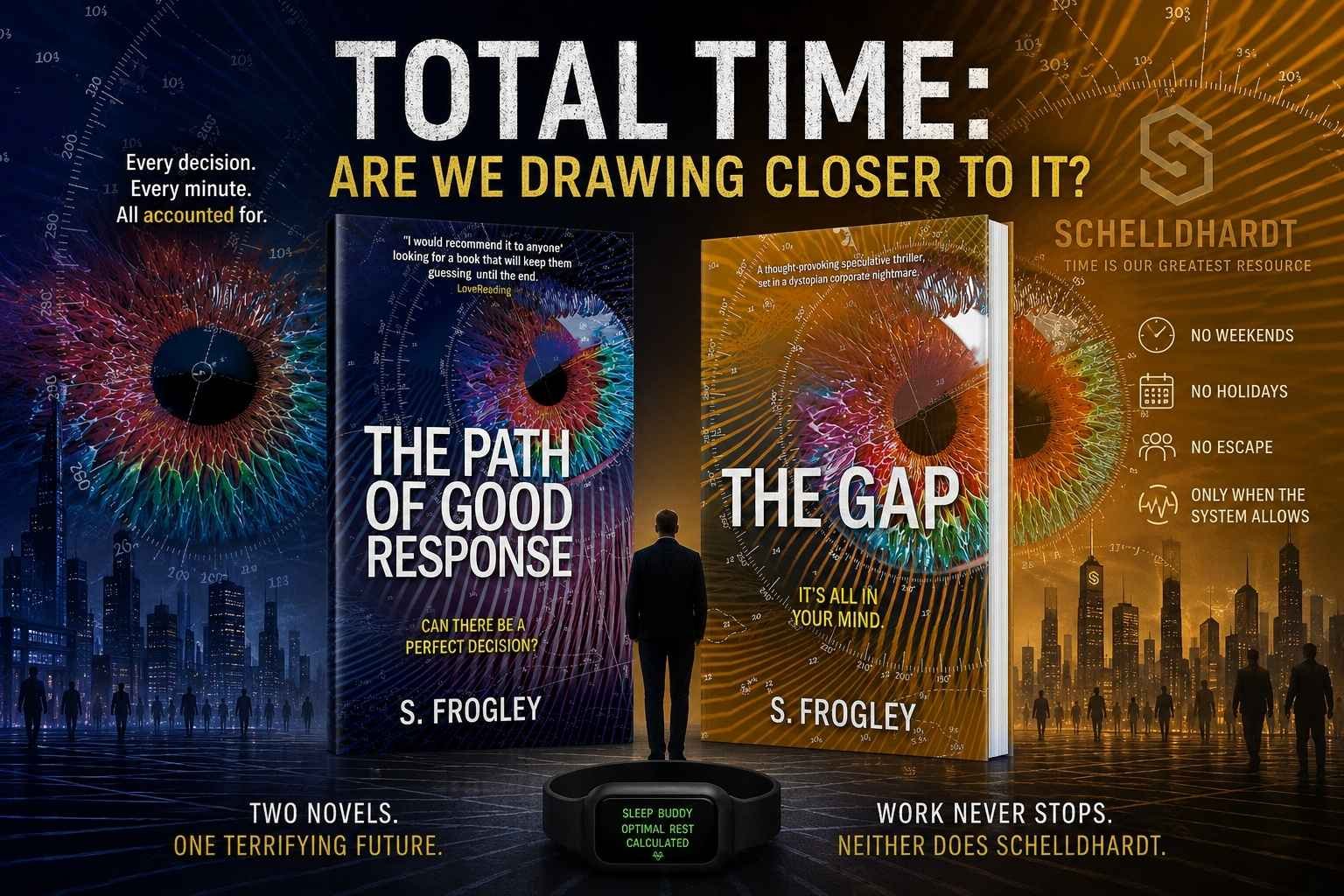
Ad: The Schelldhardt Series. Reality-bending sci-fi thrillers.
