
12 Books Like Black Mirror: The Best Speculative Fiction for Fans of AI, Corporate Dystopias and Mind-Bending Technology
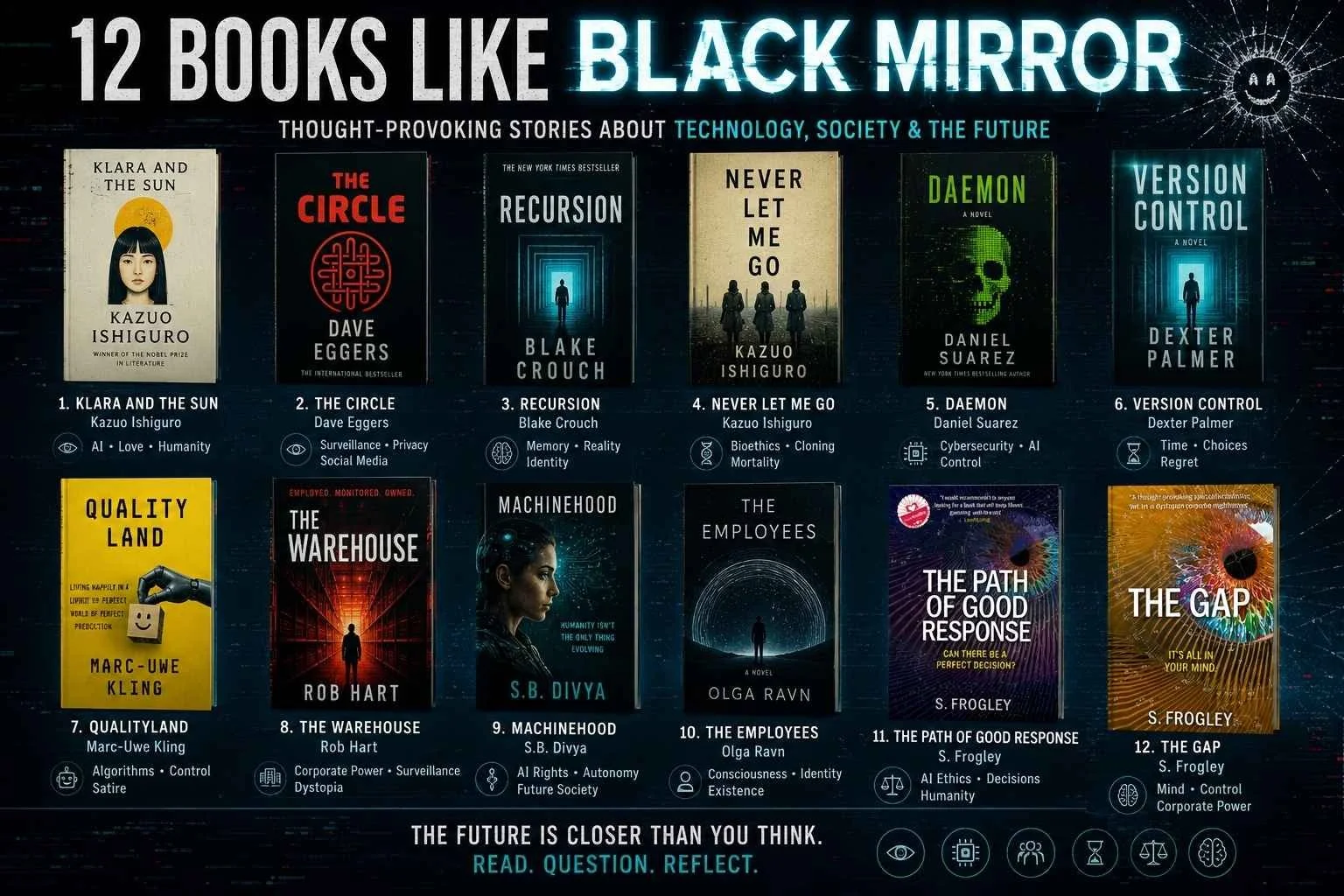
Books like Black Mirror
Black Mirror has become synonymous with intelligent speculative fiction that explores the unintended consequences of technology. Rather than imagining distant galaxies, it asks what happens when today's innovations collide with timeless human flaws. The twelve novels below capture that same blend of ethical dilemmas, psychological suspense and near-future speculation.
Quick Comparison
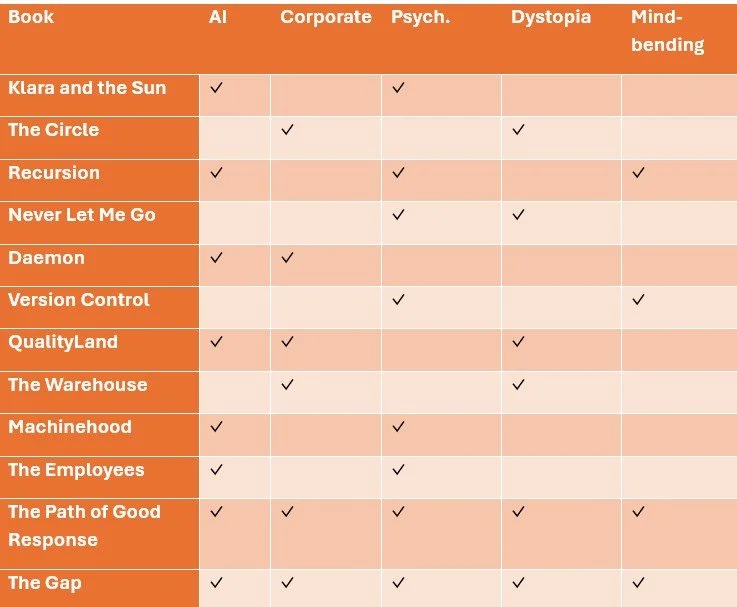
The features of these novels
Book Recommendations
1.Klara and the Sun
A moving exploration of artificial intelligence, empathy and what it truly means to be human. Told through the eyes of an Artificial Friend, it echoes the emotional depth of Black Mirror episodes such as Be Right Back and San Junipero. Unlike many AI stories, Ishiguro isn't interested in machines overthrowing civilisation. Instead, he asks a much more unsettling question: what happens when machines become capable of loving us better than we love one another?
Why you'll love it: If your favourite Black Mirror episodes are the emotional ones rather than the horror stories, this should be your first read.
Themes: Artificial intelligence, humanity, love, ethics
2.The Circle
Mae Holland lands what appears to be the perfect job at the world's most influential technology company. Gradually, however, the company's philosophy of complete transparency transforms into something disturbingly authoritarian. Published before TikTok, before AI assistants became commonplace and before social media became even more deeply woven into everyday life, Eggers' novel now feels remarkably prophetic. Fans of Nosedive will immediately recognise the obsession with public approval, while those who enjoyed The Entire History of You will appreciate its examination of surveillance and digital memory. A chilling look at social media, surveillance and the cost of total transparency. As one company grows ever more powerful, privacy becomes a thing of the past.
Why you'll love it: Because the technology already exists. That's what makes it terrifying..
Themes: Surveillance, corporate power, privacy, social media.
3.Recursion
Blake Crouch delivers a page-turning thriller about false memories and fractured reality that asks whether changing the past is ever worth the cost. It begins with a mysterious phenomenon called False Memory Syndrome. Across the world, people suddenly remember entire lifetimes that never happened. As detective Barry Sutton investigates, he discovers that reality itself is beginning to fracture. What follows is an exhilarating blend of thriller, time travel and neuroscience that asks whether our memories truly define who we are. Like the very best episodes of Black Mirror, every scientific breakthrough creates even bigger moral problems.
Fast-paced, emotionally engaging and packed with twists, this is one of those novels that's almost impossible to put down.
Why you'll love it: it feels like three Black Mirror episodes rolled into one.
Themes: Memory, identity, time, reality.
4.Never Let Me Go
Some books don't frighten you while you're reading them. They haunt you afterwards. Never Let Me Go begins as a quiet coming-of-age story at an English boarding school before gradually revealing the horrifying truth about its students' purpose. Ishiguro's restrained prose makes the revelations even more devastating. Rather than focusing on scientific spectacle, the novel explores bioethics, mortality and what society is prepared to sacrifice in the pursuit of medical progress. It's impossible not to think of Black Mirror while reading it. Both present extraordinary ideas with remarkable emotional restraint..
Why you'll love it: It's one of the most heart-breaking speculative novels ever written..
Themes: Bioethics, dystopia, mortality, humanity.
5.Daemon
Long before artificial intelligence dominated headlines, Daniel Suarez imagined software capable of reshaping civilisation after its creator's death. A deceased game designer leaves behind an autonomous program that recruits followers, manipulates financial systems and systematically dismantles existing institutions. What begins as cybercrime evolves into something much larger. Published in 2006, Daemon now reads less like fiction and more like a warning. Its exploration of automation, cybersecurity and algorithmic control feels increasingly relevant in the age of generative AI..
Why you'll love it: It's one of the smartest techno-thrillers ever written.
Themes: Automation, AI, cybersecurity, digital control.
6.Version Control
Not every Black Mirror-style story depends on shocking twists. Some simply create a quiet feeling that reality itself has shifted. Rebecca Wright's husband insists his experimental machine doesn't travel through time. Rebecca isn't so sure. Her life feels subtly different. Relationships have changed. Small details no longer match her memories. Palmer transforms an intimate story about marriage into a profound meditation on regret, memory and the countless tiny decisions that shape our lives. Rather than asking "Can we change the past?" the novel asks something even more painful: should we?.
Why you'll love it: Perfect for readers who enjoy philosophical science fiction alongside psychological drama.
Themes: Parallel realities, memory, time, regret.
7.QualityLand
This one takes a more satirical route. In a near-future society governed by algorithms, products arrive before customers know they want them, jobs are assigned by systems, and everyone’s status is efficiently quantified. When Peter Jobless receives an item he definitely did not order, he makes the radical choice to try returning it. The premise is funny until it really is not. .
Why you'll love it: QualityLand is ideal if you want the corporate absurdity of The Circle with more comic bite. It skewers the reassuring idea that an optimised life is necessarily a meaningful one.
Themes: Algorithms, consumerism.
8.The Warehouse
The company in this novel is called Cloud. It offers low prices, rapid delivery and, for employees, an entire place to live. No need to worry about the world outside when the workplace has thoughtfully become your whole world. Rob Hart’s corporate dystopia is a sharp read for anyone who finds convenience both irresistible and faintly sinister. Told through the perspectives of a Cloud employee and an undercover investigator.
Why you'll love it: it has the clean momentum of a thriller and the ugly plausibility of a future that feels uncomfortably close. Capitalism has entered the group chat, and it is monitoring it..
Themes: Corporate control.
9.Machinehood
A thought-provoking near-future science-fiction thriller set in 2095, where artificial intelligence has transformed society and humans rely on performance-enhancing drugs to compete in an increasingly automated gig economy. When a mysterious group called the Machinehood launches attacks on the corporations controlling these technologies and demands that all production of the drugs stop, former special-forces operative Welga Ramirez is drawn into a dangerous investigation. As she uncovers the truth behind the Machinehood, the novel explores artificial intelligence, human enhancement, workers’ rights, economic inequality and the increasingly blurred boundary between human and machine.. Why you'll love it: explores the increasingly blurred boundary between humans and machines.
Themes: AI ethics, human enhancement, economic inequality.
10.The Employees
An experimental novella exploring identity and consciousness aboard a spacecraft. Why you'll love it: Fans of Black Mirror will appreciate its thought-provoking ideas, moral ambiguity and lasting questions.
Themes: Consciousness.
11.The Path of Good Response
Imagine Black Mirror transplanted onto the headquarters of the world's most powerful corporation at sea. Graduate Joe Massey accepts a dream job aboard Schelldhardt's luxurious floating headquarters, only to uncover disturbing secrets about free will and engineered decision-making. Combining psychological suspense with corporate dystopia, S. Frogley's novel explores behavioural control, addiction and the ethics of manipulating the human mind. Why you'll love it: if you enjoy stories where the protagonist is at the centre of a situation they don’t quite understand, this could be for you.
Themes: Free will, corporate dystopia, psychological suspense.
12.The Gap
Reality proves surprisingly fragile in this psychological speculative thriller. As perception, memory and identity begin to unravel, an ordinary woman, Lana Carter, is drawn into a conspiracy that challenges everything she believes, while trying to find her sister Grace. With echoes of White Bear and Playtest, it explores consciousness, manipulation and the unsettling consequences of hidden power. Why you'll love it: .with big themes and a rescue story at its heart, this novel confronts the social media divisions in our society as Schelldhardt targets us in our own echo chambers.
Themes: Identity, perception, mind control, social media influence, humankind’s future.
Why Black Mirror Resonates
The series succeeds because technology is never the true villain. Instead, it magnifies human qualities such as ambition, loneliness, greed and love. The best speculative fiction holds a mirror to the present rather than predicting the future, and every book on this list does exactly that.
FAQs
What books are most like Black Mirror?
Klara and the Sun, Recursion, The Circle and The Path of Good Response all capture its blend of technology and ethical dilemmas.
What genre is Black Mirror?
Speculative fiction combining science fiction, dystopia, psychological thriller and social satire.
Are there books like Severance?
Yes. The Circle, The Warehouse and The Path of Good Response all explore corporate control and identity.
Conclusion
Whether you're fascinated by AI, corporate power or the psychology of choice, these twelve books demonstrate why speculative fiction remains one of the most powerful ways to examine our relationship with technology. If you enjoy stories that leave you questioning reality long after the final page, The Schelldhardt Series offers another journey into that unsettling intersection of innovation and human nature.
