
How to Choose Speculative Thrillers That Linger
Choosing speculative thrillers
A stranger tells you the life you remember may be a product. A corporation promises to remove human error. Someone makes one apparently perfect decision, then spends 300 pages learning what it cost. If that sends a small, delighted shiver down your spine, you already know how to choose speculative thrillers in spirit. The harder part is avoiding books that offer a clever premise, then leave you alone in a fog of jargon with no emotional stakes.
The best speculative thrillers do not merely ask, ‘What if?’ They ask, ‘What would you do when the answer turns up at your front door?’ They make the familiar feel fractionally wrong, put ordinary people under extraordinary pressure and keep the pages turning while your brain starts an argument with itself.
Start with the flavour of unreality you actually want
‘Speculative thriller’ is a roomy shelf label. It can mean dystopian surveillance states, near-future tech nightmares, parallel lives, simulations, altered memory, secret experiments or an unnervingly plausible version of tomorrow. That breadth is exciting, but it is also why recommendations can go wildly off-piste.
Begin with your preferred reality glitch. If The Matrix made you want to interrogate every green line of computer code, look for stories about constructed worlds, control systems and the people who profit from them. If The Truman Show got under your skin, you may prefer narratives about observation, performance and a character slowly realising that everyone else knows the rules. If Inception is your catnip, choose books with layered perception, unstable memory and a plot that rewards paying attention.
This is not about finding a book that copies your favourite film beat for beat. Please, no one needs a knock-off in a suspiciously familiar coat. It is about identifying the feeling you want: paranoia, wonder, intellectual vertigo, moral dread or the delicious panic of not knowing whom to trust.
How to choose speculative thrillers with actual stakes
A high-concept premise is the invitation. Stakes are why you stay up past midnight saying, ‘One more chapter’, with all the conviction of a person who has made several poor but understandable choices.
Before choosing a book, find out what the main character can lose. Is it their freedom, family, identity, career, memory or grip on reality? A good speculative thriller gives its wild idea a human pressure point. You do not have to share the protagonist’s life to understand the terror of being misrepresented by a system, manipulated by an employer or told that your own recollection is unreliable.
Be a little wary of blurbs that only describe the setting. ‘In a future where feelings are regulated...’ is a start, not a story. The useful question is what happens when one person refuses, fails or finds a loophole. Look for a character caught in a choice rather than simply touring an imaginative world.
This is especially true when the book involves a huge company, government or supposedly benevolent technology. Corporate menace works best when it is not evil for the sake of a villain monologue. The most chilling antagonists have a pitch deck, a mission statement and a perfectly polished reason why their expansion is good for everyone. Their language sounds reassuring right up until it starts sounding familiar.
Decide how much puzzle you enjoy
Some readers want a thriller that hands them clues and trusts them to assemble the picture. Others want the rug pulled, but would also like the rug to have existed in the first place. Both are fair. Your ideal level of complexity matters.
If you love making theories, choose stories with competing versions of events, carefully planted details and a mystery that deepens before it resolves. Reviews that mention ‘mind-bending’, ‘layers’ or ‘a finale that recontextualises everything’ can be promising signs. They can also be a warning label if you prefer a clean, linear chase.
If you want momentum first, seek descriptions that foreground a deadline, pursuit, disappearance or dangerous discovery. The speculative idea can still be ambitious, but the plot should have a pulse. A book does not need to explain every last mechanism to be satisfying. It does need to play fair with its own emotional logic.
The sweet spot for many readers is a thriller that makes you think without making you feel as though you have forgotten to revise for an exam. Clever is brilliant. Clever plus gripping is the whole point.
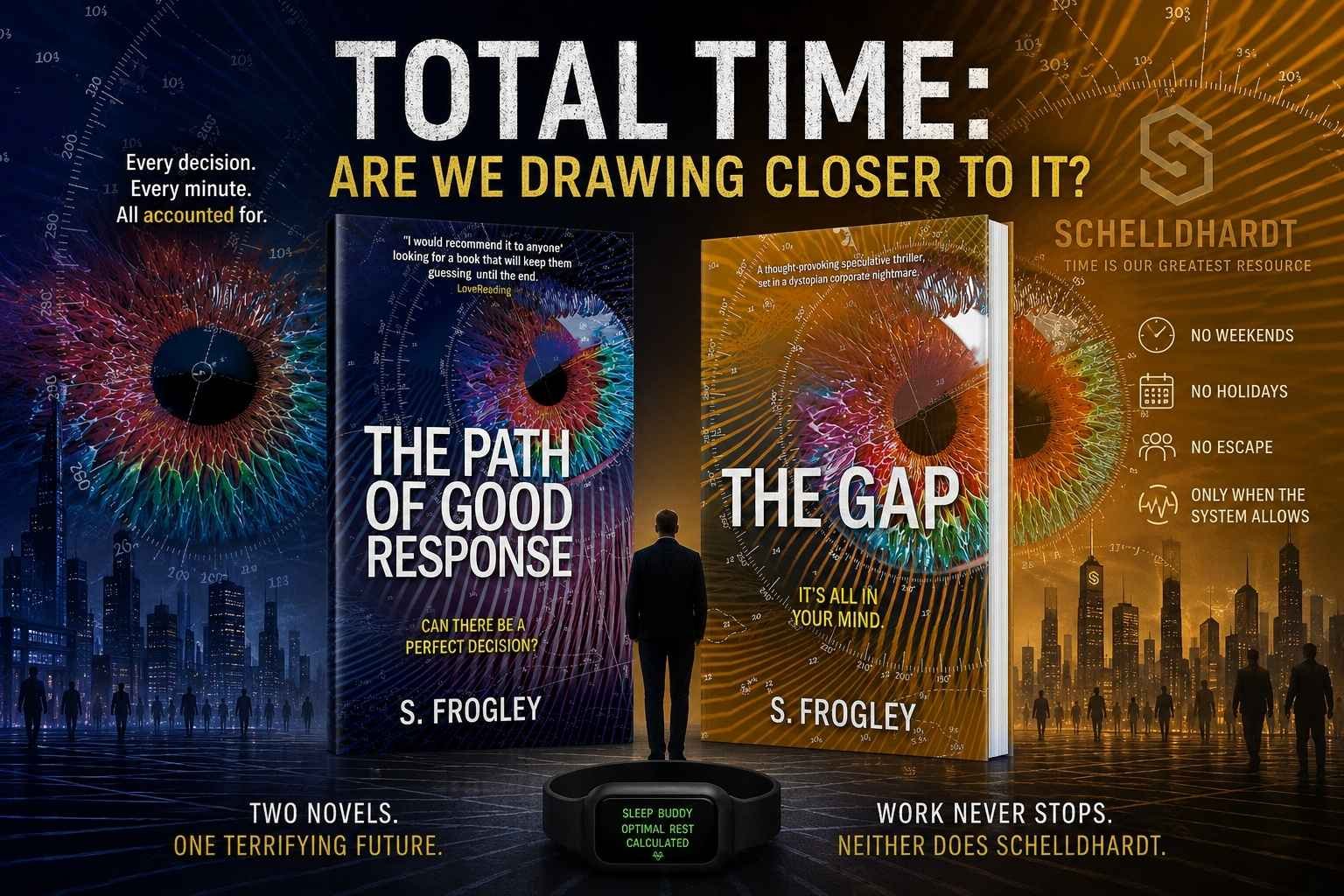
The Schelldhardt Series. Speculative thrillers with thought-provoking ideas.
Check the book’s moral temperature
Speculative thrillers can be cold in the best possible way: sharp, unsettling and clinically precise. But there is a difference between a book with a deliberately detached tone and one that has forgotten people are the reason we care.
Think about whether you want bleakness, hope or a messy blend of both. Dystopian fiction often examines systems too vast for one person to defeat cleanly. That can produce an ending that is ambiguous, compromised or quietly devastating. If you need justice served with a bow on top, check reviews for words such as ‘uplifting’, ‘satisfying’ or ‘cathartic’.
On the other hand, if you enjoy fiction that leaves a pebble in your shoe, do not automatically avoid the words ‘unsettling’ and ‘open-ended’. A conclusion can refuse easy answers while still delivering a real payoff. The difference is whether the book has been asking a meaningful question all along, rather than hiding an answer because it has misplaced it.
For this genre, the moral question often matters more than the gadget. Would a perfect decision still be yours if an algorithm made it? Is comfort worth surveillance? Can a company improve humanity without treating humans as raw material? These are not decorative themes. They are the engine.
Use reviews like a reader, not a hostage negotiator
Ratings alone are a slightly chaotic compass. A three-star review saying, ‘Too philosophical, not enough action’, might be the exact recommendation you needed. Likewise, a glowing review praising a breakneck plot may steer you towards a book that does not pause long enough for the ideas to land.
Read a handful of reviews and look for patterns, especially around pacing, clarity and ending style. Ignore complaints that simply reflect a reader wanting a different book. Pay attention when several people mention the same issue: an underdeveloped premise, characters who feel like chess pieces, a slow middle or a twist that relies on information the reader could not possibly have known.
Also consider the comparison titles people use. A book described as ‘for fans of Black Mirror’ may promise an icy, single-idea warning. One compared with Blade Runner may offer atmosphere, identity questions and noirish ambiguity. Comparisons are shorthand, not legally binding contracts, but they help you locate the book on the spectrum between brainy concept and white-knuckle thriller.
Do not mistake bleak for profound
A grim setting can be powerful. Endless misery, however, is not automatically depth wearing a black roll-neck. The strongest books know exactly what their darkness reveals: a fear about power, conformity, exploitation, intimacy or the stories we tell ourselves to feel safe.
Ask whether the premise enlarges the human drama. Does the speculative element expose something real about choice or control? Or is it mostly there to make the cover look expensive? There is no shame in wanting entertaining escapism, either. A fast, inventive thriller can be every bit as worthwhile as a more meditative one. You are choosing your reading mood, not sitting an exam in Serious Literature.
Follow the questions that bother you
The most memorable speculative thrillers tend to find a private anxiety and turn it into a public nightmare. Maybe you cannot stop thinking about how much of modern life is outsourced to platforms. Maybe the idea of an employer knowing your every habit feels less futuristic than it should. Maybe you are fascinated by the possibility that certainty itself could be dangerous.
That is your route in. Choose books whose core question nags at you before you have read page one. Heptagon Books' The Gap, for example, will appeal to readers drawn to blurred realities, corporate ambition and the uneasy thought that a better system may not be better for everyone inside it.
A speculative thriller should leave you with more than a solved mystery and a clever final image. Choose the one that makes everyday life look slightly stranger on the walk to the kettle. The best kind of book does not just ask whether reality can be altered. It makes you wonder who has already started.
