
Total Time: Are We Drawing Closer to It?
Total Time: Are We Drawing Closer to It?
One of the enduring strengths of dystopian fiction is that it rarely invents entirely new ideas. Instead, it takes existing trends, follows them to their logical conclusion, and asks readers whether the future it depicts is really as impossible as it first appears. George Orwell did not invent surveillance, Aldous Huxley did not invent consumerism, and Margaret Atwood did not invent religious extremism. Each simply imagined what might happen if those forces continued unchecked.
What is Total Time?
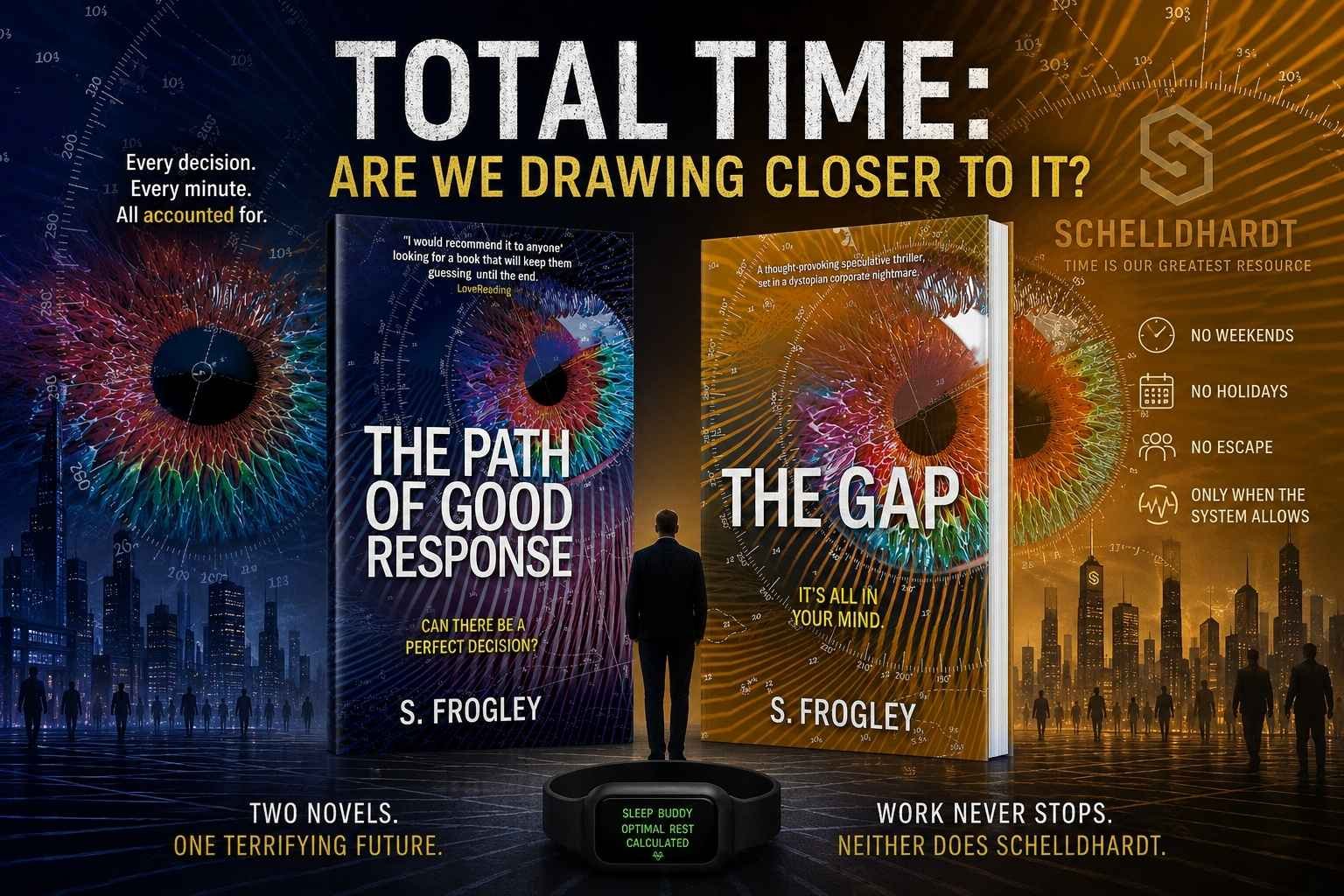
The same question can be asked of Total Time, the fictional employment system operated by Schelldhardt in The Path of Good Response and The Gap. Schelldhardt is the world's largest corporation, one whose relentless pursuit of growth overrides every other consideration. Within its organisation there is no concept of a working day, no weekends, no public holidays and no recognised religious festivals. Christmas Day is simply the twenty-fifth of December. Easter becomes another date in the calendar. Time itself no longer belongs to individuals but to the company. Employees are expected to remain permanently available. The only interruption to work comes not because workers have earned time to themselves, but because a device known as the Sleep Buddy determines that rest is necessary to maintain productivity. Even sleep is no longer a personal choice; it becomes another corporate resource to be managed as efficiently as possible.
Pure fiction?
At first glance, Total Time appears to be an exaggerated warning designed to serve the needs of a dystopian novel. Yet good dystopian fiction is rarely about predicting the future with precision. Its purpose is to ask uncomfortable questions about the present. The question raised by Total Time is not whether society will literally abolish weekends or public holidays, but whether we are already moving towards a culture in which work increasingly occupies every corner of our lives, justified by the promise of continual economic growth. Over the last few decades, the distinction between work and personal life has become steadily less defined. Advances in technology have undoubtedly improved productivity and created remarkable flexibility. Millions of people now work remotely, avoid lengthy commutes and enjoy greater freedom over where and when they perform their jobs. For many, this has been an overwhelmingly positive development. However, technology has also quietly altered expectations. Emails arrive at every hour of the day. Instant messaging applications blur the boundary between professional and personal conversations. Video meetings take place across multiple time zones, meaning someone is almost always expected to be available. Smartphones have ensured that work is never more than a few seconds away. Few employers explicitly demand that staff remain constantly connected, but many cultivate cultures in which rapid responses become the norm. Employees answer emails during holidays, managers participate in meetings while travelling, and professionals routinely check messages late in the evening or early in the morning. None of these individual actions appears particularly significant, yet collectively they represent a subtle shift in how society thinks about work.
Total Time, in this sense, may not arrive through legislation or corporate decree. It may emerge gradually through changing expectations, until permanent availability simply feels normal.
Who sees the benefits?
Behind this changing relationship with work lies a more fundamental question: who benefits from continual economic growth? Modern capitalism has delivered extraordinary achievements. Over the past century, global living standards have risen dramatically. Medical advances have transformed healthcare, technological innovation has reshaped everyday life, and hundreds of millions of people have escaped extreme poverty. It would be impossible to discuss the modern economy honestly without acknowledging these successes. Markets have proven exceptionally effective at encouraging innovation, rewarding entrepreneurship and allocating resources in ways that have generated unprecedented prosperity. Yet prosperity alone does not tell the whole story.
While global wealth has increased substantially, its distribution has become increasingly uneven. Data from organisations such as the World Inequality Database, the OECD and Oxfam consistently shows that wealth has become more concentrated among the highest earners. The wealthiest ten per cent of the world's population own the overwhelming majority of global wealth, while the richest one per cent control an extraordinary share of financial assets. At the same time, many households have experienced decades of relatively stagnant wage growth once inflation is taken into account, even as housing, education and healthcare costs have risen. This apparent contradiction has become one of the defining economic debates of the twenty-first century. If economies continue to grow while increasing numbers of people struggle to purchase homes, save for retirement or maintain living standards enjoyed by previous generations, then growth alone cannot be regarded as a complete measure of success.
Growth is bad?
This is not to suggest that economic growth is undesirable. Growing economies create employment, generate tax revenues and fund public services. Rather, it raises the question of whether the rewards of that growth are being distributed in ways that benefit society as a whole.
The fictional world of Schelldhardt offers one possible answer. Within Total Time, employees exist primarily as contributors to corporate expansion. Every hour not spent increasing productivity represents wasted potential. While fictional, the underlying philosophy is recognisable. In many modern businesses, labour is viewed primarily as a cost to be managed. Salaries, pensions, training, annual leave and employee benefits all appear on financial statements as expenses that reduce profits. Shareholders, meanwhile, expect continual improvements in earnings, often measured quarter by quarter.
There is nothing inherently unethical about seeking profit. Businesses must remain profitable in order to survive, invest and employ people. Indeed, without successful companies there would be fewer opportunities, slower innovation and weaker economic growth. The difficulty arises when shareholder returns become the sole measure of corporate success. If every decision is judged exclusively by its contribution to profit, then reducing employee costs becomes an almost inevitable objective.
In the world of Total Time, this logic reaches its ultimate conclusion. If every additional hour can generate value, why would an organisation voluntarily allow employees to disconnect? Fiction merely extends a real incentive structure to its extreme.
What about pensions?
Whenever criticism is directed towards large corporations, a common response quickly follows. Most ordinary people, it is argued, are shareholders too. Through workplace pensions, index funds and retirement savings, millions of employees indirectly own shares in the companies for which they work. Higher corporate profits therefore produce stronger pension returns, meaning that workers ultimately benefit from successful businesses. There is considerable truth in this argument. Pension systems across much of the developed world depend heavily upon financial markets. Rising share prices generally strengthen pension funds, helping to provide income during retirement. Without profitable companies, many pension schemes would undoubtedly struggle to meet their long-term obligations. Yet this explanation is not quite as straightforward as it first appears. Ownership within financial markets remains highly unequal. Individuals with higher incomes generally contribute more to pensions, own additional investments and accumulate greater financial assets throughout their lives. Those who already possess substantial wealth therefore receive a disproportionately large share of investment returns. Meanwhile, workers with modest pensions often experience the immediate consequences of cost-cutting measures through wage restraint, reduced job security or increasing workloads.
Imagine an employee whose salary barely keeps pace with inflation while the company records record profits. The value of their pension may increase modestly over time, but they have simultaneously experienced years of reduced purchasing power. In such circumstances, are they genuinely benefiting from corporate success, or merely receiving partial compensation decades later for income they might otherwise have earned today?The answer will vary depending on individual circumstances, but the example illustrates that the relationship between employees and shareholders is considerably more complicated than popular narratives often suggest.
So is growth necessary?
It also prompts a broader question. Is the constant pursuit of growth genuinely necessary to sustain pension systems, or has this become a convenient justification for an economic model that increasingly prioritises investors over workers?There may not be a simple answer, but the question deserves serious consideration.The expectation of perpetual growth has become one of the defining characteristics of modern capitalism. Governments celebrate rising GDP. Companies are expected to increase profits every year. Investors punish organisations whose earnings merely remain stable, even when those earnings are already substantial. Quarterly financial reporting reinforces the belief that growth should never slow. This expectation creates its own pressures. A successful company earning billions of pounds each year may still be regarded as underperforming if profits increase by only two per cent instead of four. Remaining profitable is no longer sufficient; continual acceleration becomes the expectation, but logically growth cannot be sustained forever. Schelldhardt reach a point where growth cannot be sustained, called Cloudburst, in the novels.
This isn’t the future we we were promised.
Within this growth environment, productivity improvements are rarely viewed as opportunities to reduce working hours. Instead, they frequently become opportunities to increase output.Historically, many economists imagined a different future. In 1930, John Maynard Keynes predicted that technological progress would eventually allow people to work dramatically fewer hours while maintaining comfortable living standards. Productivity would rise, machines would perform repetitive tasks and leisure would become one of humanity's greatest achievements. Technology certainly fulfilled part of that prediction. Modern workers can accomplish tasks in minutes that once required days. Artificial intelligence promises to automate even more complex forms of work. Yet rather than reducing working hours, technology has often expanded expectations. Employees remain connected outside office hours. Meetings take place across continents. Productivity software measures performance in ever greater detail. Artificial intelligence has the potential either to liberate workers from routine tasks or to monitor every aspect of their professional lives with unprecedented precision. The technology itself is neither good nor bad. Its impact depends entirely upon the incentives that guide its use.
Is capitalism the problem?
This brings us to another important consideration: whether capitalism itself is the problem.Critics of modern capitalism are sometimes accused of advocating communism by default, but history demonstrates that centrally planned economies carried profound weaknesses of their own. The Soviet Union achieved rapid industrialisation but struggled with chronic shortages, inefficiency and limited innovation. Maoist China experienced catastrophic famine, while Eastern European planned economies frequently failed to meet consumer demand. Governments proved no more immune to poor decision-making than corporations. Capitalist economies, by contrast, have demonstrated extraordinary capacity for innovation, entrepreneurship and wealth creation. Competitive markets encourage experimentation and reward successful ideas in ways that centrally planned systems often failed to replicate. Neither system, however, offers a complete solution.
Communist economies often distributed scarcity more equally but struggled to generate prosperity. Capitalist economies generate remarkable prosperity but can allow wealth and influence to become increasingly concentrated.Perhaps the debate has always been framed too narrowly. Rather than asking whether capitalism or communism represents the superior model, the more useful question may be how societies balance markets with safeguards that ensure prosperity is widely shared. Most successful modern economies already operate as mixed systems, combining private enterprise with varying degrees of regulation, taxation and public services. The debate is therefore less about choosing between two opposing ideologies than about deciding where the balance should lie.
Institutional funds
Another significant change has occurred almost unnoticed over recent decades. Increasing proportions of global businesses are now owned not by individual investors but by vast institutional funds managing the pensions and savings of millions of people. Passive investing has transformed financial markets, concentrating ownership within a relatively small number of asset managers acting on behalf of enormous numbers of ordinary savers.This creates a curious relationship. Workers contribute labour to companies while simultaneously owning tiny fractions of those same organisations through their pensions. Consumers purchase products from businesses that they indirectly own. Yet despite this widespread ownership, meaningful influence over corporate decision-making remains concentrated among relatively few institutional investors. The average pension holder has little say over executive pay, environmental policy, working conditions or long-term corporate strategy. Ownership has become increasingly collective, but decision-making remains highly centralised.Again, the fictional world of Schelldhardt exaggerates an existing trend rather than inventing a completely new one.
Conclusion
If Total Time serves as a warning, it is not because every aspect of its society seems inevitable. Rather, it reminds readers that major social changes often occur gradually. Few people would willingly vote to abolish weekends or public holidays. Yet many voluntarily answer work emails on Sunday evenings. No government proposes eliminating annual leave, yet countless employees spend holidays checking messages "just in case." No corporation openly claims ownership of an employee's life, yet digital technology increasingly allows work to accompany us everywhere. Each individual compromise appears reasonable. Together they slowly redefine what is considered normal.
Perhaps this is why dystopian fiction remains so valuable. It encourages readers to recognise patterns while there is still time to influence them. The central question posed by Total Time is ultimately not economic but philosophical. What is the purpose of an economy? If economic growth exists primarily to improve human wellbeing, then technological progress should eventually grant people greater freedom over how they spend their lives. If, however, growth becomes an end in itself, then every improvement in productivity merely creates pressure for still greater output. Leisure becomes inefficiency. Rest becomes a cost. Time itself becomes another resource waiting to be optimised. There are alternatives worth exploring. Employee ownership, cooperative business models, stronger worker representation on company boards, revised approaches to executive remuneration and broader measures of national success that extend beyond GDP all represent attempts to balance economic efficiency with social wellbeing. None is perfect, and none eliminates the need for profitable businesses. However, they demonstrate that the current model is not the only possible one.
The future is unlikely to resemble either the free-market ideal imagined by some economists or the centrally planned systems attempted during the twentieth century. It will almost certainly continue to evolve as a mixture of competing ideas, technologies and political choices. What fiction like The Path of Good Responseand The Gap contributes is not a prediction, but a perspective. Total Time forces readers to examine trends that already exist and ask where they might ultimately lead if left unquestioned.
