
Steve Frogley Book Review - Worth Reading?

Steve Frogley’s Books
If your ideal thriller leaves you staring at the ceiling, mildly suspicious of reality and suddenly ready to interrogate the ethics of corporate power, this Steve Frogley book review is for you. Frogley writes speculative fiction with a philosophical pulse: the kind that asks a huge question, then refuses to let the answer stay safely theoretical.
His novels, including The Path of Good Response and The Gap, sit in that deliciously unnerving space occupied by stories such as The Matrix, Inception and The Truman Show. Reality is not necessarily lying to you. But it may be withholding a few details. Quite a lot of details, actually.
Steve Frogley book review: the short version
Steve Frogley is worth reading if you like ideas-led thrillers that still remember people have feelings, loyalties and a talent for making terrible decisions under pressure. His work is not speculative fiction that uses a cool premise as window dressing. The premise is the pressure cooker. It changes the moral temperature of every choice made inside it.
The appeal is in the collision of scale and intimacy. These are stories interested in systems, institutions and the unnerving logic of growth at all costs, but they do not treat human beings like chess pieces. The questions land because they affect characters, not just concepts.
That matters. Plenty of high-concept thrillers can explain a world-changing idea; fewer make you feel the personal cost of living with it. Frogley’s fiction is for readers who want both the big thought and the creeping sense that their own answer to the central dilemma might be less noble than they hoped.
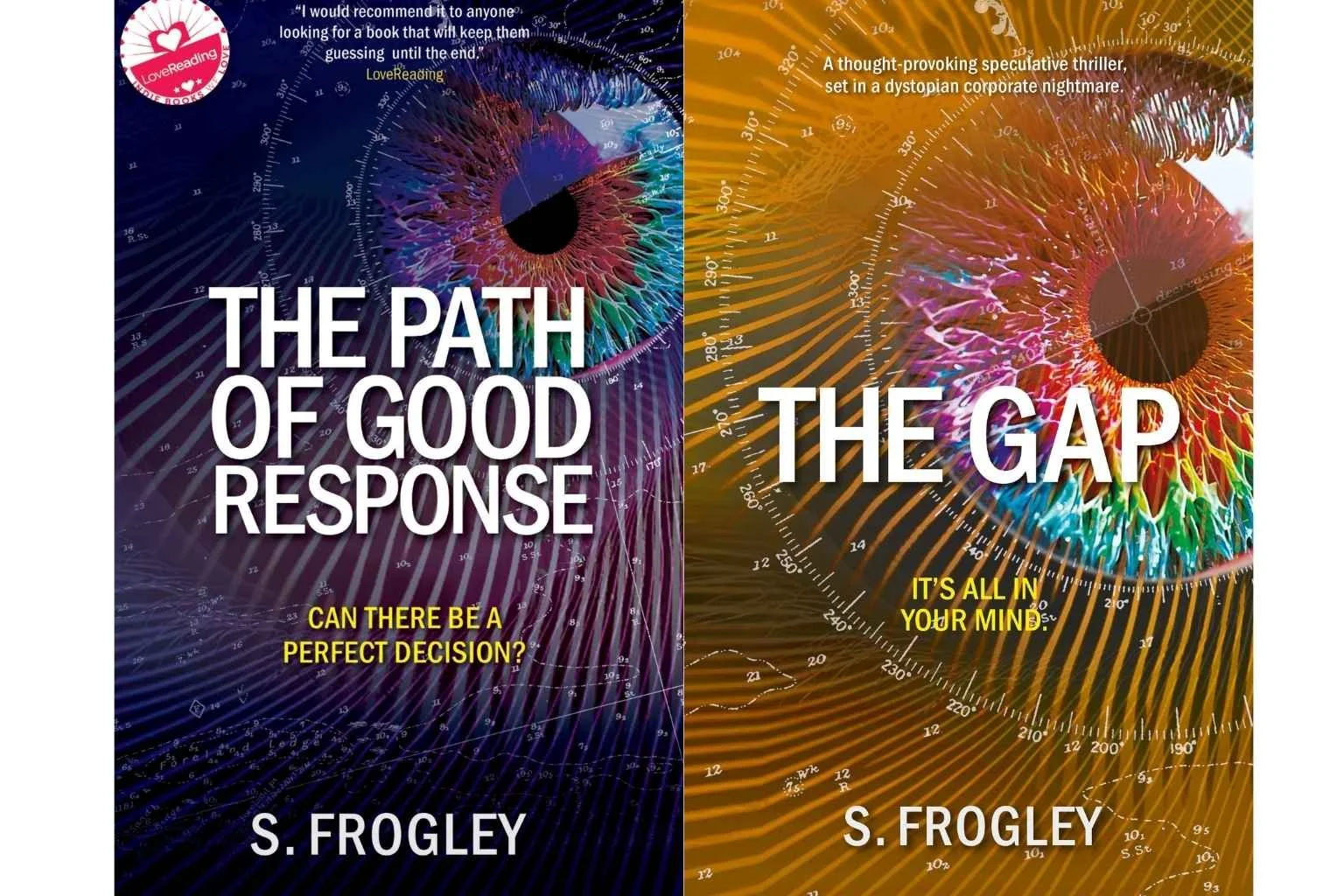
Steve Frogley’s current novels: The Path of Good Response and The Gap.
The real hook is the question behind the plot
A Steve Frogley novel is likely to appeal to readers who enjoy a premise with teeth. Not simply, “What if this happened?” but, “What if this happened and made ordinary human certainty look a bit flimsy?” It is an excellent engine for a thriller because the stakes are not merely about escaping danger. They are about deciding what counts as truth, freedom, responsibility and a life well lived.
In The Path of Good Response, the title itself points towards one of Frogley’s recurring fascinations: the temptation to treat morality as something that can be measured, optimised or engineered. It is a compellingly awkward thought. Most of us would like to believe we make good decisions through wisdom, empathy and the occasional very strong cup of tea. But what happens when an outside force claims it can improve the process?
That territory has obvious dystopian potential, yet it also feels close enough to everyday life to prickle. We already live among algorithms that recommend, rank, predict and nudge. A story that pushes those impulses towards their logical extreme does not need flying cars or laser battles to feel unsettling. It just needs to make the familiar one notch too efficient.
The Gap carries a similarly enticing promise for readers who enjoy reality-bending fiction. The title has that perfect speculative-thriller quality: simple, mysterious and faintly ominous. What is the gap? A flaw in the world, a missing piece of knowledge, a distance between what people see and what is true? The pleasure is in following a narrative prepared to make uncertainty part of the experience rather than a problem to be tidied away immediately.
Thoughtful, but never a lecture
There is a specific type of reader who hears “philosophical speculative thriller” and worries they are about to be assigned homework. Fair. Nobody wants to emerge from a novel clutching a highlighter and a sense of personal failure.
Frogley’s appeal is that the ideas are there to create tension, not to win an argument. The best speculative fiction does not hand readers a laminated answer sheet. It gives them a situation so persuasive, so morally tangled, that they cannot help testing their own beliefs against it.
That makes these books a strong match for fans of stories where the central revelation changes the meaning of what came before. If you enjoy the moment when a thriller makes you mentally rewind three chapters, welcome. You are among friends.
There is also an anti-corporate edge to this kind of fiction that feels particularly timely. The most frightening fictional organisations are rarely scary because someone in a boardroom twirls a moustache. They are scary because their language sounds reasonable. Efficiency. Progress. Convenience. Scale. The danger arrives dressed as a business case, which is always much creepier than a cape.
Who will enjoy Steve Frogley’s books?
Frogley is a particularly good fit for readers who want their speculative fiction to be intelligent without becoming chilly. If you like films where a supposedly perfect system has one very alarming catch, or novels that turn a familiar modern anxiety into an all-consuming premise, there is plenty here to get your brain fizzing.
You may especially enjoy his work if you like:
reality-bending thrillers where certainty is in short supply;
dystopian fiction that questions who benefits from a “better” world;
corporate power presented as a genuine threat rather than background scenery;
moral dilemmas with no cosy, obvious answer;
high-concept stories that retain a human centre.
The trade-off is straightforward. Readers looking for a purely action-first thriller, with every chapter racing towards the next explosion, may find the reflective side more prominent than expected. These books invite you to think as well as turn pages. For the right reader, that is the point. For someone seeking uncomplicated escapism after a week of inbox drama, it may depend on mood.
The comparison shelf: where does he fit?
Comparisons can be useful, provided we do not flatten every speculative thriller into “like The Matrix, but with fewer leather coats”. Frogley belongs in the broad conversation around fiction that makes reality itself feel questionable, particularly stories interested in control, consent and the cost of supposedly rational systems.
Readers who respond to the psychological uncertainty of Inception, the manufactured world of The Truman Show or the systemic dread of The Matrix will recognise the appeal. The connection is not about copying their plots. It is about a shared willingness to ask whether the structure holding life together deserves our trust.
That is a fertile place for contemporary fiction. We are increasingly used to invisible systems shaping what we buy, watch, believe and prioritise. A novel that looks at those pressures through a speculative lens can be entertaining, yes, but also wonderfully irritating in the best sense. It follows you about afterwards. It makes the next cheerful promise of optimisation sound faintly sinister.
A good choice for a book club with opinions
If your book club is happiest when everyone politely says, “I liked the setting,” then moves on to biscuits, a Steve Frogley title may cause mild disruption. There will be questions. Someone will defend the system. Someone else will say that is exactly how it starts. A third person will have a very detailed theory by page 80.
That makes these novels excellent for readers who like fiction to create conversation rather than simply fill a commute. The most satisfying speculative thrillers offer the rare double hit: a story compelling enough to keep moving, and an idea substantial enough to debate once the final page is turned.
Heptagon Books publishes fiction for readers who want that spark of recognition: the feeling that a book understands the conversations we are already having about technology, power and the strange bargains modern life keeps asking us to make.
So, should you read Steve Frogley? If you want a thriller that treats your intelligence as part of the suspense, absolutely. Pick up The Path of Good Response or The Gap when you are ready for a premise that may rearrange a few assumptions - and perhaps leave a small, useful gap between what you thought you knew and what you are now willing to question.
