
Why We Love Stories That Make Us Question Reality
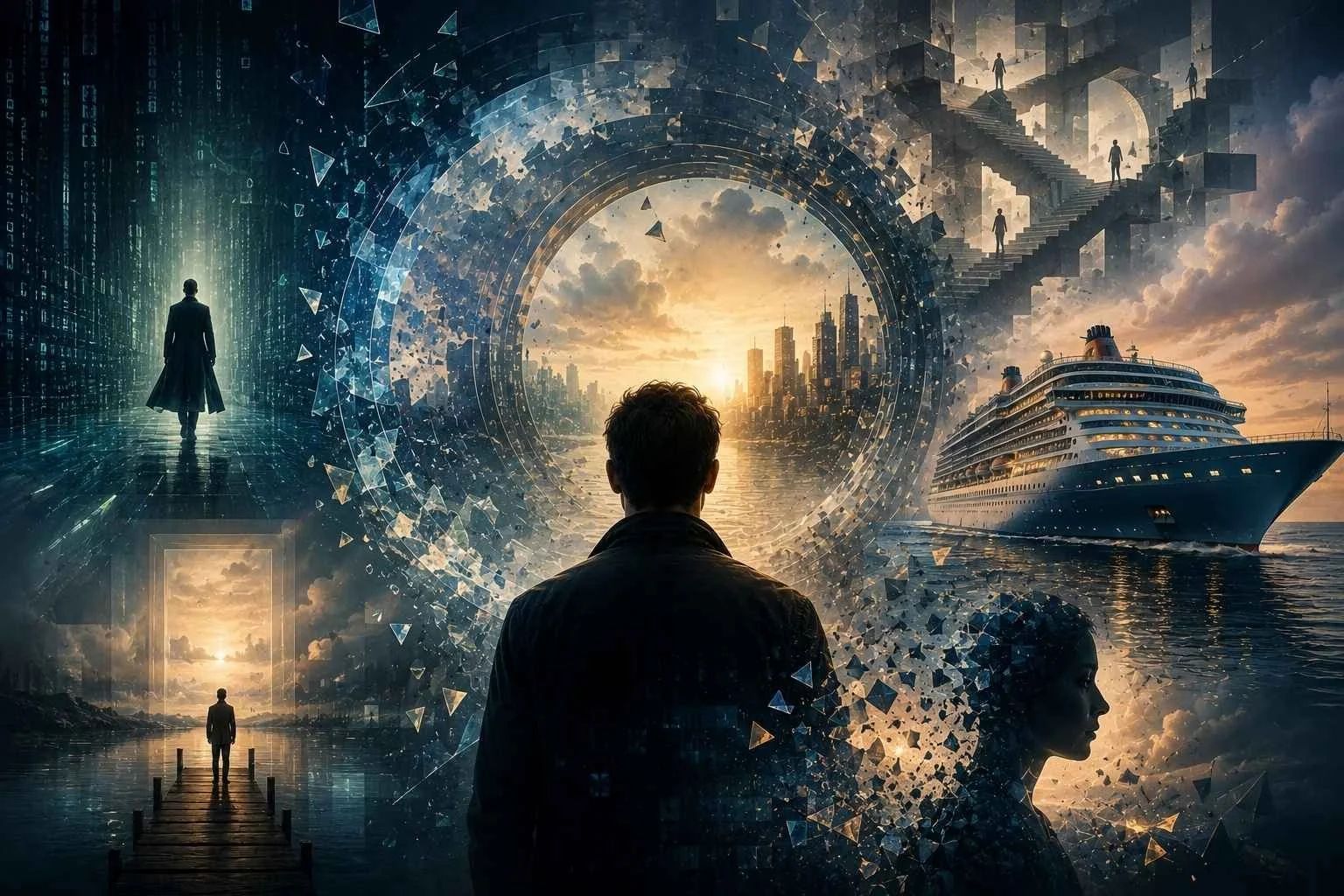
The appeal of stories that make us question reality.
Why We Love Stories That Make Us Question Reality
There is a particular kind of story that stays with us long after the credits roll or the final page is turned. It isn't simply because of an exciting plot twist or a cleverly constructed mystery. Instead, these stories quietly ask one unsettling question: What if the world you trust isn't the world that's really there?
Films such as The Matrix, Inception and The Truman Show have become modern classics because they do more than entertain. They challenge our assumptions about reality itself. They encourage us to question our memories, our choices, our identities, and even whether the people and institutions we trust deserve that trust at all.
These stories occupy a fascinating space between science fiction, psychology, philosophy and thriller. They remind us that certainty may be an illusion, and that discovering the truth often comes at a personal cost.
It's no surprise that readers continue to seek out novels exploring similar territory. As artificial intelligence grows more capable, corporations become increasingly influential and our digital lives shape how we think and behave, stories about unreliable realities feel less like fantasy and more like thought experiments about our own future.
Reality Is More Fragile Than We Think
Most stories ask, "What happens next?" Blurred reality stories ask something much more fundamental: "What is actually happening?" That single shift changes everything. Rather than presenting the world as a stable backdrop, these narratives make reality itself part of the mystery. The audience becomes a detective alongside the protagonist, constantly reassessing previous assumptions. Every revelation forces us to reinterpret earlier events.
This is why these stories reward repeat viewings or rereads. Once you know the truth, entirely different meanings emerge from scenes that originally appeared straightforward.
The Matrix: Escaping Comfortable Illusions
Perhaps no modern film illustrates this better than The Matrix. Neo begins as an ordinary man with an unshakable feeling that something isn't right. His world appears completely normal, yet everything feels subtly artificial. When he discovers humanity exists inside a simulated reality, the story transforms from an action film into a profound philosophical exploration.
The famous red-pill choice has become shorthand for choosing uncomfortable truth over comforting illusion. What makes The Matrix so enduring isn't simply its groundbreaking visual effects. It is the unsettling suggestion that reality itself could be manufacture, and that those with power might benefit from keeping people unaware.
The film also asks whether ignorance is ever preferable. If an illusion provides happiness, is discovering the truth always worth the cost? Those questions remain surprisingly relevant more than twenty-five years later.
Inception: Can We Ever Trust Our Own Minds?
Christopher Nolan's Inception shifts the uncertainty inward. Rather than questioning the external world, it questions consciousness itself. Dreams feel completely real while we're inside them. Nolan constructs an intricate thriller around this simple observation, layering dreams within dreams until both the characters and audience struggle to distinguish one level of reality from another.
Even after multiple viewings, the ending remains deliberately unresolved. Does the spinning top fall? More importantly, does it matter? The ambiguity is the point. Reality is no longer defined by objective evidence but by personal experience and emotional acceptance.
The film reflects an enduring fascination with subjective truth. Our memories, perceptions and experiences may not always be reliable, yet they shape who we become.
The Truman Show: Manufactured Lives
Unlike the technological spectacle of The Matrix or the dream architecture of Inception, The Truman Show presents an elegantly simple premise. One ordinary man unknowingly lives inside the world's biggest television programme. Everything surrounding Truman has been carefully designed. His friendships. His fears. His ambitions. Even the weather.
The horror comes not from violence or monsters but from manipulation. Truman believes he is making free choices while unseen producers quietly shape every aspect of his life.
Long before social media algorithms, personalised advertising and recommendation systems became everyday realities, the film explored how environments can subtly influence behaviour. Today, it feels more prophetic than ever.
Why These Stories Feel More Relevant Than Ever
Today's world often feels stranger than fiction. Artificial intelligence generates convincing images and videos of events that never happened. Algorithms determine much of what we read, watch and believe. Corporations possess unprecedented amounts of behavioural data. Online platforms personalise information so extensively that two people can inhabit entirely different versions of reality while living next door to one another.
Against this backdrop, stories about uncertain realities no longer seem purely speculative. Instead, they become metaphors for modern life.
The Psychology of Uncertainty
Humans naturally seek certainty. Yet fiction allows us to explore uncertainty in safety. Readers enjoy solving puzzles. We enjoy spotting clues. Perhaps surprisingly, we even enjoy being deceived, provided the deception ultimately makes sense. Blurred reality stories invite us to become active participants. Every conversation may contain hidden meaning. Every coincidence might matter. Every trusted authority could be misleading. Instead of simply consuming a narrative, we construct one ourselves. That intellectual participation is one reason these stories remain so memorable.
Identity Under Pressure
When reality changes, identity changes with it. Who are you if your memories are false? Who are you if your decisions have been manipulated? Who are you if your entire life has been carefully engineered? These questions connect nearly every great reality-bending story. The external mystery becomes an internal one. The protagonist isn't merely trying to understand the world. They're trying to understand themselves. That emotional journey gives speculative fiction its lasting depth.
Corporate Power: The Modern Architect of Reality
Interestingly, many contemporary speculative thrillers have shifted away from governments as the primary source of control. Instead, corporations increasingly occupy that role. This reflects changing cultural anxieties. The world's largest companies influence communication, entertainment, healthcare, finance and technology. They collect extraordinary quantities of personal data. They shape behaviour not through force but through systems, incentives and algorithms.
Their influence is often invisible. That makes them ideal antagonists for stories where reality itself becomes uncertain.The greatest threat is no longer obvious oppression, but subtle manipulation.
A New Evolution of the Genre
This evolution can be seen in recent speculative fiction that explores not simply whether reality is real, but whether our own choices genuinely belong to us. The Path of Good Response, the opening novel in the Schelldhardt Series, imagines a dystopian future dominated by Schelldhardt, the world's largest corporation. When graduate Joe Massey is unexpectedly recruited to the company's luxurious headquarters aboard an enormous ship at sea, it appears to be an extraordinary opportunity. His main motivation is simple: staying close to Rachel, who has been a constant presence throughout his education and working life. Yet almost immediately, reality begins to fracture. Disturbing dreams blur into waking life. Joe's opinions seem inexplicably valuable to senior executives. The corporation appears unusually interested in the workings of the human mind.
As Joe story progresses alongside the enigmatic former CEO Arnold Shendi, the novel steadily transforms from corporate thriller into something far more philosophical. Questions of autonomy, manipulation and free will replace straightforward mystery. At the heart of the story lies an intriguing proposition: what if perfect decisions could be engineered? If poor choices, even addictions, could be controlled from within the mind, would humanity become better... or simply easier to control? Rather than relying on spectacular action, the novel builds tension through uncertainty. Readers are encouraged to question not only the motives of Schelldhardt, but also Joe's own understanding of reality, particularly in the notorious red lounge.
The sequel, The Gap, expands these ideas into an even more ambitious exploration of human behaviour.
Its central concept is deceptively simple: the gap is the space where intention becomes action. It is where human weakness is exposed. It is where every decision ultimately takes shape. In the novel, that hidden space becomes the next global battlefield. Schelldhardt seeks to exploit the gap through its vast technological and online influence, while a secretive organisation known as the Friary attempts to stop them.
At the centre of the conflict is Lana Carter, searching for her missing sister Grace after Grace disappears while working for Schelldhardt. Joining forces with Joe Massey, Lana uncovers a conspiracy that stretches far beyond one missing person. The fate of Grace becomes inseparable from the future of the gap itself.
Like the finest examples of speculative fiction, The Gap shifts the unreliable reality away from physical illusion and towards something arguably more unsettling: influence. Instead of asking whether the world is real, it asks whether our decisions are truly our own, and what if a corporation over-stepped its influence. If the space between thought and action can be understood, or manipulate, then free will itself becomes uncertain.
This feels like a natural evolution of the themes explored in The Matrix, Inception and The Truman Show. Those stories questioned the nature of reality. The Schelldhardt novels ask what happens once reality remains intact but the processes shaping human behaviour become invisible. In an age increasingly defined by algorithms, behavioural psychology, artificial intelligence and digital influence, that possibility feels remarkably plausible.
The Path of Good Response and The Gap
Why We'll Never Stop Questioning Reality
Every generation creates its own reality-bending stories. The world and the nature life are beyond explanation, and we will never understand the true reality of our existence, a conclusion Joe reaches in The Path of Good Response, deciding our choices and actions are more significant than the question.
