
Laughing at the Dehumanisation of Dating Apps (Instead of Crying!)
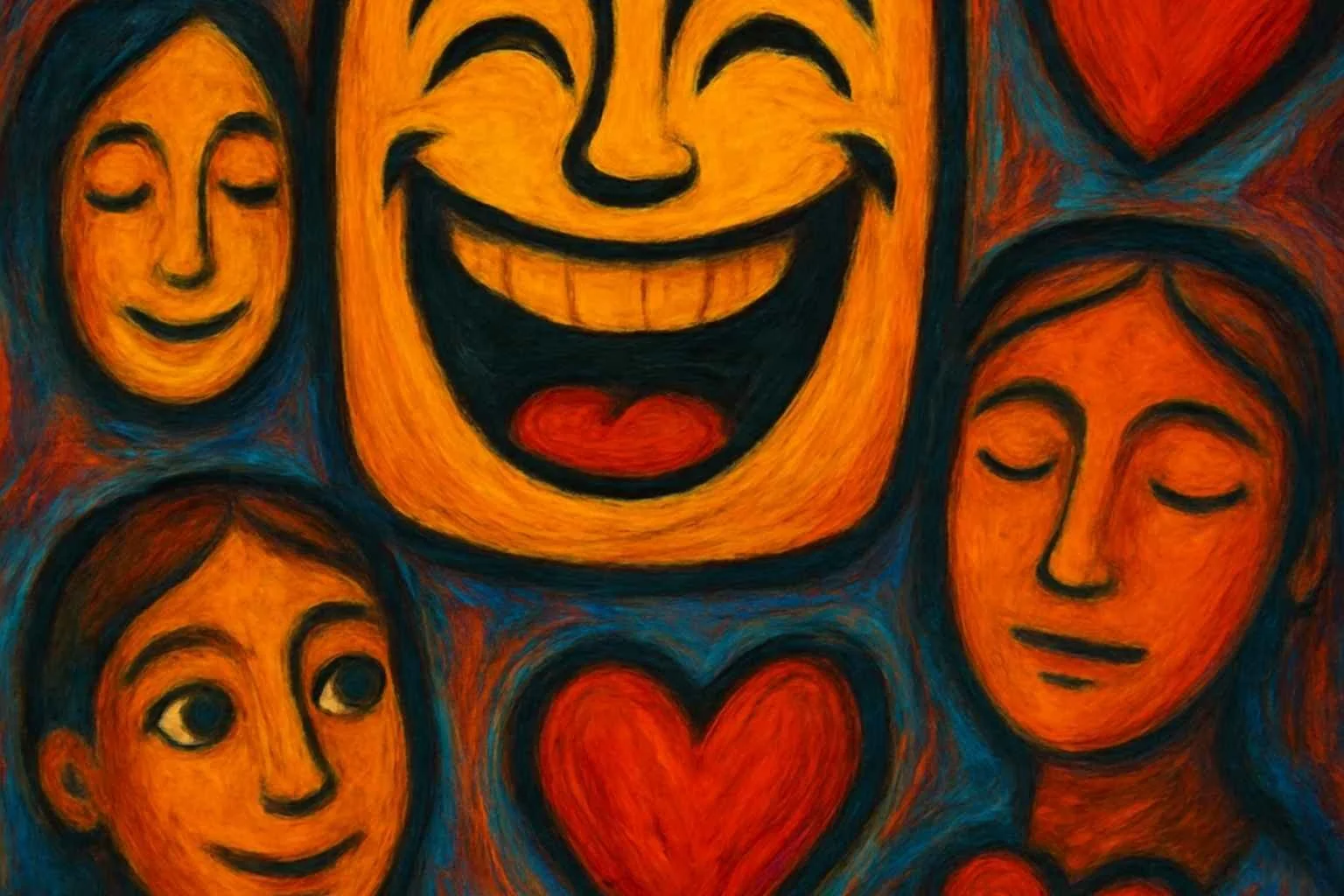
The dehumanisation of dating app swiping. The Attraction Abacus is the logical conclusion.
There was a time, not long ago, but already sepia-toned in the cultural imagination, when romance involved at least a mild degree of mystery. You might meet someone at a party and spend the evening wondering what they did for a living, whether they liked dogs, and why they laughed just a little too hard at your mediocre joke about olives. You would go home with questions. Delicious, maddening, human questions.
Now, of course, you go home with a thumb cramp.
Dating apps have streamlined romance with the ruthless efficiency of a supermarket self-checkout. Potential partners glide past like discounted avocados: inspect, reject, reject, reject, “maybe later,” reject. In theory, this is progress. In practice, it feels suspiciously like sorting recyclable materials: plastic here, glass there, humans everywhere but nowhere in particular.
The promise of dating apps was simple: more choice, more efficiency, more love. The reality is also simple: more choice, more efficiency, and an unsettling sense that you are both the shopper and the product. You are browsing, yes, but you are also being browsed, evaluated, and silently judged by strangers who will never know that you once cried at a documentary about unusually loyal penguins.
Instead, they know three things: your face, your height (if you dared to include it), and your ability to make a pun about tacos.
Welcome to the marketplace of reduced humanity.
The Profile: A Life in 280 Characters (Give or Take a Gym Selfie)
Creating a dating profile is a uniquely modern existential exercise. It asks the question: If you had to compress your entire being into six photos and a handful of sentences, what would you say?
The answers, predictably, converge into a kind of global sameness.
“I love travel.”
“I don’t take myself too seriously.”
“Fluent in sarcasm.”
“Looking for someone who can make me laugh.”
Somewhere along the way, we all agreed to become identical.
The photos don’t help. There is the obligatory group shot (which one are you?), the gym mirror selfie (ambiguous emotional tone), the candid laugh (clearly staged), and the “I am holding a dog that may or may not be mine” shot. Each image is a calculated move in a silent negotiation: Will this make me seem attractive but not vain? Fun but not chaotic? Interesting but not exhausting?
It is less a portrait of a human being and more a PowerPoint presentation titled Why You Should Consider Dating Me (Q2 Edition).
And yet, despite all this effort, the outcome is brutally binary: swipe right, swipe left. Yes. No. Human. Not-human-enough.
The Swipe: Micro-Rejections at Scale
Rejection, once a rare and devastating experience, has been democratised. Now you can experience it hundreds of times before breakfast.
Of course, you don’t see most of these rejections. They happen invisibly, behind the scenes, as other users flick past your carefully curated existence in a fraction of a second. But you feel them. In the eerie quiet of an empty inbox. In the matches that never speak. In the conversations that die after “Hey.”
The swipe mechanic is the real genius, and the real villain, of dating apps. It transforms human connection into a reflex. There is no time for nuance, no room for contradiction. You are either appealing or you are not, and that decision is made faster than you can say “I actually have a very complex inner life.”
What’s lost in this process is not just patience, but curiosity. People become impressions, then data points, then nothing at all.
You are no longer a person who loves Sunday mornings and fears disappointing your parents. You are a face at a particular angle with a vaguely witty caption about brunch.
The Algorithm: Love, Quantified (Sort Of)
Behind the scenes, dating apps insist they are doing something sophisticated. There are algorithms, they say. Compatibility scores. Behavioural insights. Preferences refined over time.
But from the user’s perspective, it often feels less like a thoughtful matching system and more like a slot machine with a romantic theme. You swipe, you wait, you hope. Occasionally, something lights up.
The problem is not that dating apps use data, it’s that they pretend data can fully capture something as unruly as human attraction.
What makes someone appealing is not just how they look, how old they are, or what they do. It’s how they speak, how they listen, how they react when a waiter gets their order wrong. It’s the rhythm of conversation, the shared silences, the strange alchemy of two personalities colliding in just the right way.
None of that fits neatly into a profile.
So instead, we get proxies. Smiling photos. Job titles. Carefully selected hobbies that suggest depth without risking specificity. We construct versions of ourselves that are legible to the algorithm, even if they are not entirely true.
In doing so, we participate in our own reduction.
Enter: The Logical Conclusion
If dating apps already reduce us to a handful of traits and images, it’s only a small step, philosophically speaking, to reduce us further.
Why stop at profiles when you could have a number?
This is the deliciously unsettling premise at the heart of The Attraction Abacus, a rom-com novel that takes the logic of modern dating to its inevitable, absurd extreme. In its world, the messy, ambiguous business of human attraction has been distilled into a single, authoritative score.
No more swiping. No more guessing. Just a number.
The Attraction Abacus app evaluates each user based on a set of quantifiable attributes:
Looks: Symmetry is king. The closer your face aligns with mathematical ideals, the higher your score climbs.
Age: Time, ever the romantic villain, steadily nudges your number downward.
Wealth: Financial success buys more than comfort: it buys desirability.
Intelligence: Brains matter, at least insofar as they can be measured and ranked.
Personality: Reduced, inevitably, to metrics and surveys that attempt to capture charm in numerical form.
Add it all together, and you get your score. Your value. Your place in the romantic hierarchy.
It is, on the surface, horrifying. It is also uncomfortably familiar.
The Comfort of Being Reduced
Here’s the twist: part of the appeal of something like the Attraction Abacus is that it removes uncertainty.
Dating is hard not just because of rejection, but because of ambiguity. Does this person like me? Am I good enough? What does “good enough” even mean?
A single score answers all those questions with brutal clarity. You are a 72. They are an 85. The system, in its cold wisdom, suggests you aim within your range.
There is a certain relief in that. No more overthinking. No more mixed signals. Just arithmetic.
But that relief comes at a cost.
Because the moment you accept a number as a complete representation of your worth, you surrender something essential. You trade complexity for clarity. You become legible, but less real.
And once everyone has a number, the game changes. People begin to optimise. They tweak their lives not for joy or meaning, but for incremental gains in their score. A slightly better job. A slightly stricter diet. A carefully curated personality.
Self-improvement becomes score-improvement.
Romance becomes strategy.
The Absurdity of Precision
One of the great comedic strengths of The Attraction Abacus lies in how it exposes the absurdity of trying to measure the immeasurable.
How, exactly, do you quantify personality? Is kindness worth more than wit? Does a good sense of humor offset mild selfishness? Can generosity compensate for a tendency to talk too much about your fantasy football team?
And intelligence: what kind? Academic? Emotional? The ability to remember obscure film trivia?
Even looks, which seem straightforward, are riddled with cultural bias and personal variation. Symmetry might be mathematically pleasing, but human attraction has always had a soft spot for the unconventional: the crooked smile, the distinctive nose, the face that becomes more beautiful the longer you look at it.
The Abacus, in its quest for objectivity, flattens all of this into numbers. It pretends that attraction is universal, stable, and predictable.
In reality, it is anything but.
The Human Rebellion
What makes a story like this compelling, beyond its satirical bite, is the inevitable rebellion against the system.
Because no matter how efficient or persuasive the scoring becomes, it cannot fully extinguish the stubborn, irrational nature of human connection.
People will still fall for the “wrong” person. They will still be drawn to those outside their prescribed range. They will still choose chaos over compatibility, mystery over math.
They will, in other words, continue to be human.
And that’s where the romance lives.
The central tension in The Attraction Abacus is not just between characters, but between two competing visions of love: one that is orderly, measurable, and optimised, and one that is messy, unpredictable, and gloriously inefficient.
The former promises safety. The latter delivers meaning.
Back to Reality (Sort Of)
It’s tempting to dismiss the idea of a single attraction score as pure fiction, but the truth is we are already inching in that direction.
Every like, every match, every message response contributes to a kind of informal ranking. We learn, over time, where we “stand” in the dating ecosystem. We adjust our expectations accordingly.
We may not have a number displayed on our profiles, but we feel its presence.
The difference is that current dating apps still leave room for surprise. For the unexpected match. For the conversation that shouldn’t work but does. For the person who looks ordinary in photos but becomes extraordinary in person.
They leave room, in other words, for humanity to slip through the cracks.
The Final Calculation
So where does this leave us?
Dating apps, for all their flaws, are not inherently evil. They connect people who might never otherwise meet. They create opportunities for relationships, friendships, and the occasional excellent anecdote.
But they also encourage us to see each other, and ourselves, as simplified versions of reality. To prioritise what is easy to display over what is hard to express.
They nudge us, gently but persistently, toward reduction.
The Attraction Abacus simply asks: what happens if we follow that logic all the way to the end?
The answer is both funny and unsettling. A world where love is calculated, attraction is ranked, and people are distilled into a single, definitive score.
A world that is, in many ways, not so different from our own, just a little more honest about what it’s doing.
And perhaps that’s the real joke.
Because even in a universe governed by perfect algorithms and impeccable math, there will always be someone who looks at the numbers, shrugs, and says:
“Yeah, but I just like them.”
No equation can quite account for that.
