
7 Corporate Dystopian Books That Feel Too Real
Dystopian corporate novels
A faceless government is frightening. A faceless government with a loyalty scheme, a glossy app and a cheery slogan about ‘making life better’ is somehow worse. That is the particular chill of corporate dystopian books: the threat does not arrive in jackboots. It arrives in branded packaging, with next-day delivery and an option to accept all cookies.
This corner of speculative fiction understands that the most persuasive villains do not always make grand speeches. Sometimes they offer convenience. Sometimes they promise meaningful work. Sometimes they insist that surveillance is simply a feature designed with your wellbeing in mind. The best of these novels make capitalism’s most familiar language feel just a little bit cursed.
Why corporate dystopian books hit differently
Classic dystopias often imagine the state controlling its citizens through force. Corporate dystopias are more slippery. Their companies control housing, food, work, information, healthcare, entertainment or even the story people tell about themselves - and they make the arrangement look voluntary.
That is why the genre has such a strong BookTok-to-‘wait, should I delete every app?’ aftertaste. It takes recognisable anxieties - data harvesting, gig work, monopolies, algorithmic feeds, private space travel, corporate wellness - and gives them one ruthless nudge forward. Not every book here is a full apocalypse. Some are satirical, some intimate, some weird enough to make you stare at a wall for a bit. All understand that a corporation’s hunger to grow has no natural finish line.
There is a trade-off, though. A novel can be brilliantly sharp about systems and still leave readers cold if its characters are merely ideas in trainers. The titles that endure give us people caught inside the machine: ambitious, complicit, frightened, in love, trying to pay rent, trying to get out.
7 corporate dystopian books to put on your radar
1. The Space Merchants by Frederik Pohl and C. M. Kornbluth
Originally published in 1952, this is the grandparent of the corporate dystopia, and it remains alarmingly lively. In a future where advertising agencies effectively run the world, a high-flying copywriter is assigned to sell the public on colonising Venus. The small complication: Venus is lethal.
Its satire is broad, clever and gloriously unimpressed by consumer culture. The book sees advertising not as a harmless persuasion game but as a political force capable of manufacturing desire, consent and reality itself. Some details belong firmly to its era, but its central joke - that a product can be marketed more successfully than it can be delivered - has aged disturbingly well.
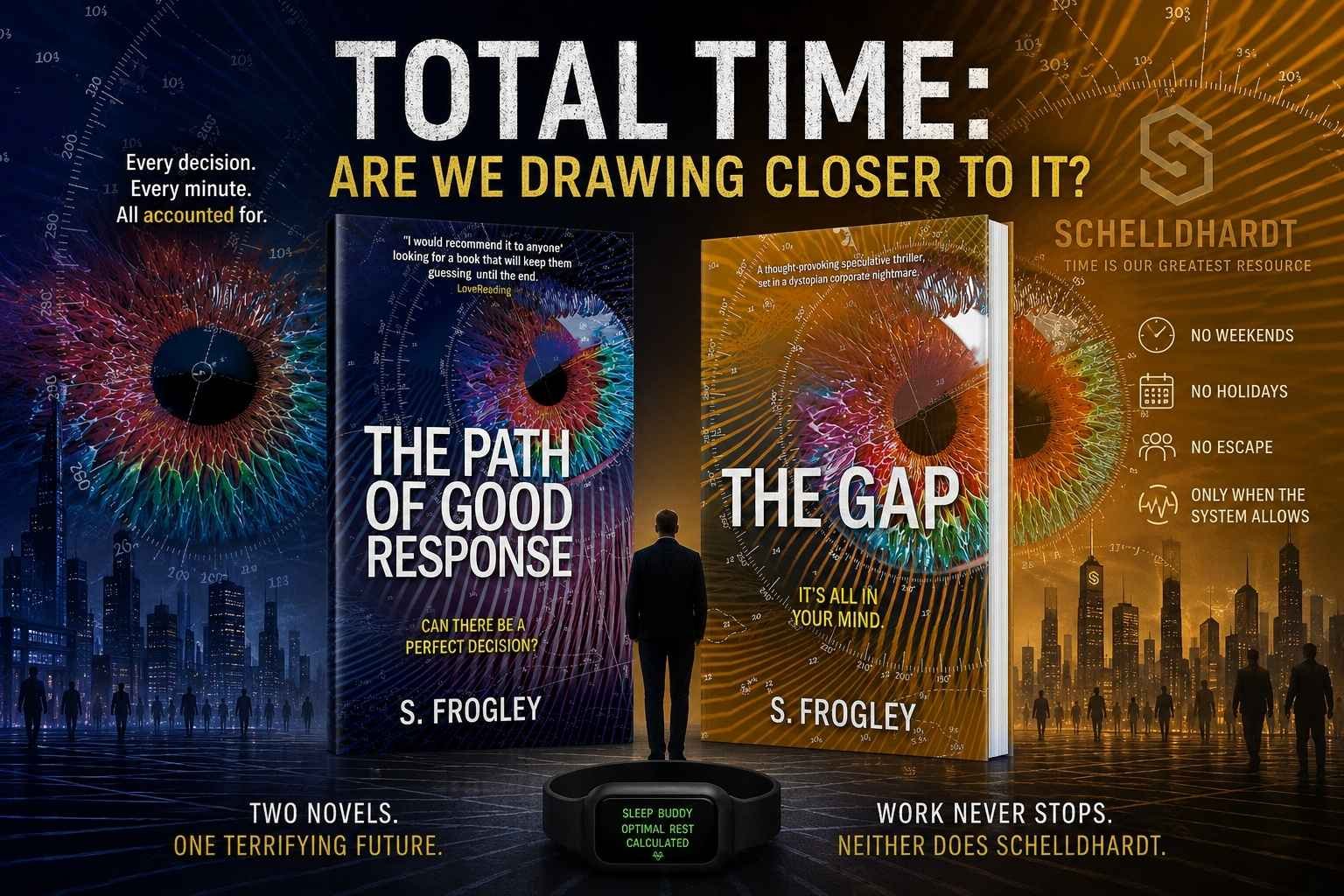
2. The Schelldhardt Series by S. Frogley
Schelldhardt, the world's largest company, is willing to do anything to grow.
Bombarding the global population with binary choices through their social media channels, Schelldhardt is targeting us in our echo chambers for their own unsettling purposes.
Thought-provoking speculative thrillers, set in a dystopian corporate nightmare, these are two stand-alone stories, The Path of Good Response and The Gap.
3. Jennifer Government by Max Barry
Max Barry asks a very reasonable question: what if corporations became so powerful that your surname showed where you worked? Then he answers it with brand warfare, assassins, a pair of absurdly coveted trainers and a pacey plot that refuses to sit quietly in a boardroom.
This is corporate dystopia with a grin full of teeth. Jennifer Government is not subtle, and it knows it. Its exaggerated free-market nightmare is the point: every public good has been privatised, every person has become a customer or a product, and nobody in marketing has ever heard the phrase ‘perhaps we should not’. Read it if you want satire that moves like a thriller.
4. Oryx and Crake by Margaret Atwood
Atwood’s corporate world is not one giant logo stomping on civilisation. It is more insidious than that. Scientific corporations operate in gated compounds, selling engineered health, beauty and security to the privileged while everyone else gets the fallout.
Told through the memories of Snowman, seemingly one of the last surviving humans, Oryx and Crake mixes ecological collapse, genetic engineering and corporate vanity with real emotional damage. It can be bleak, so this is not a cosy weekend read. But its vision of innovation without accountability feels especially potent now, when ‘can we?’ so often races ahead of ‘should we?’
5. The Circle by Dave Eggers
The company at the centre of The Circle has the clean campus, the perfect messaging and the terrifyingly frictionless ambition of every tech firm that claims it merely wants to connect people. Mae Holland lands a dream job there, only to find that privacy is treated as suspicious, silence is treated as selfish and total visibility is treated as moral progress.
Eggers is deliberately blunt in places, which will work better for readers who enjoy big, discussable ideas than those looking for intricate world-building. Yet the book’s core question is a killer: what happens when a company persuades us that being watched is the same thing as being safe, honest and included? Spoiler: the group chat gets dystopian fast.
6. The Warehouse by Rob Hart
If giant online retailers, warehouses the size of towns and the creeping replacement of public life with delivery logistics already give you the heebie-jeebies, The Warehouse will not soothe you. In Hart’s near future, Cloud has become the employer, retailer and landlord for vast numbers of people living in its company facilities.
The novel follows two employees with very different motives for joining. That dual perspective matters because corporate power is never only imposed from above. People need wages, stability and a place to live. The system works precisely because it offers something real before it takes everything else. This is a propulsive, accessible thriller with a premise close enough to the present to feel like a forecast.
7. The Employees by Olga Ravn
For readers who prefer their dread strange, spare and quietly cosmic, The Employees is the pick. Set aboard a ship owned by the mysterious Ravn corporation, the novel unfolds through witness statements from human and humanoid workers. Objects brought aboard from a newly discovered planet begin to unsettle the crew, exposing grief, desire, hierarchy and the brittle language of corporate management.
It is not a conventional thriller, and it is not interested in explaining every corner of its world. Think haunting fragments rather than a neat plot engine. But that form is part of the effect: workers speak in the polished, evasive vocabulary institutions use when something deeply human is going wrong. Short book. Enormous atmosphere. Absolutely no chance of making your next HR email feel normal.
What to read next depends on your flavour of dread
If you want fast, high-concept satire, start with Jennifer Government. If technology and social media are your personal red flag, choose The Circle. For a page-turning corporate nightmare grounded in work, housing and consumption, go for The Warehouse.
Readers after bigger ideas and slower-burning unease will probably get more from Oryx and Crake, The Employees or The Mountain in the Sea. And if you like stories where the rules of reality seem unstable, the corporation is expanding at any cost, and every apparently perfect solution has an ominous catch, Heptagon Books’ The Gap belongs in the conversation too.
The real pleasure of this genre is not predicting the future with spooky accuracy. It is noticing the stories we are already being sold about convenience, progress and growth - then asking who wrote the small print. Pick the book that matches your preferred flavour of existential alarm, and keep a healthy suspicion of any company that calls itself your friend.
