
12 Best Conspiracy Theory Sci-Fi Books to Read
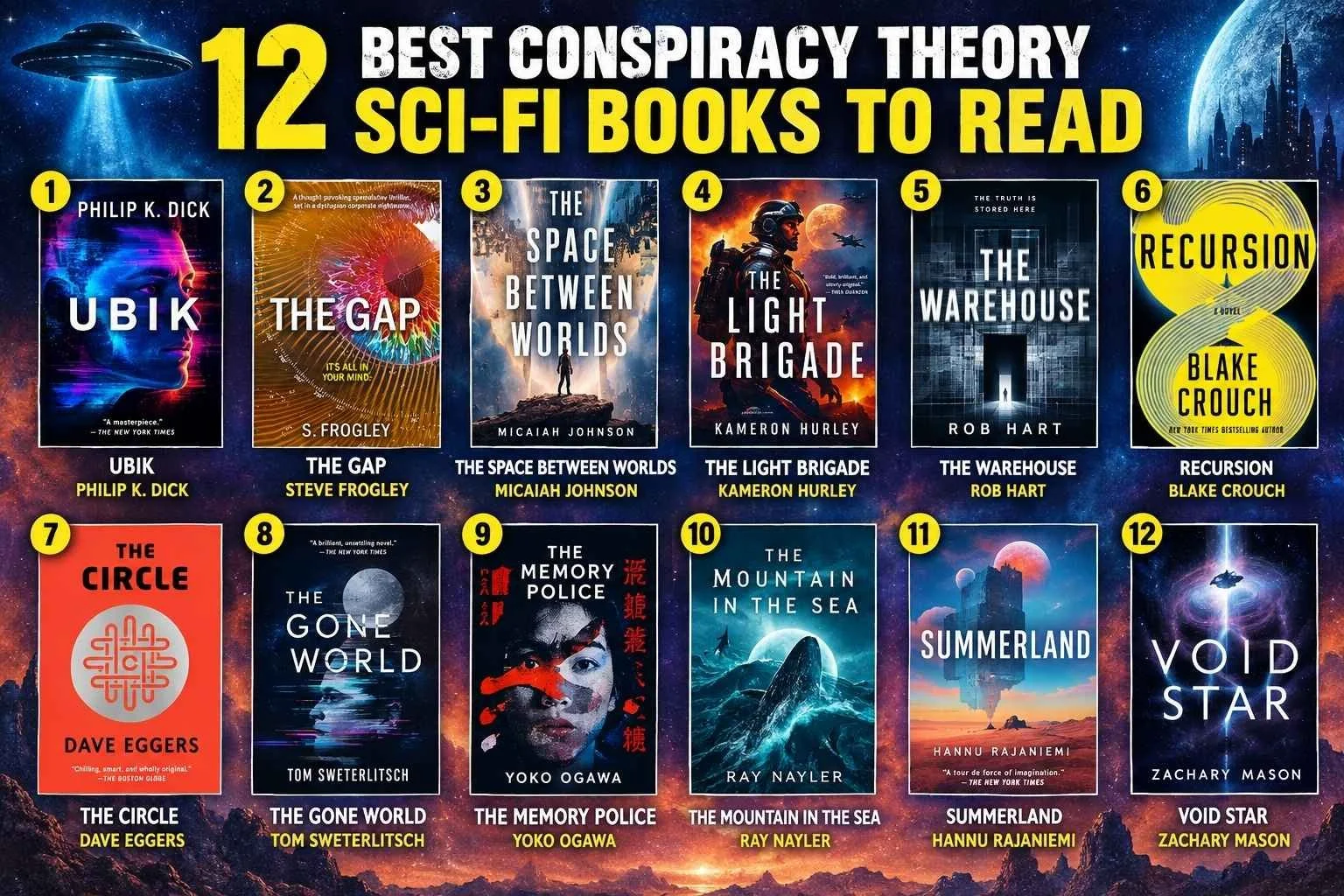
Best Conspiracy Theory Sci-Fi Books to Read
Someone is lying. The corporation has a secret floor. Your memories have been edited. The moon landing probably happened, but the man selling you that answer is behaving very oddly. The best conspiracy theory sci-fi makes paranoia feel less like a fringe hobby and more like a perfectly sensible response to the evidence.
These books are not all tinfoil-hat fare. The strongest ones use conspiracy as a pressure cooker for bigger questions about technology, capitalism, identity and whether a comfortable life is worth having if somebody else wrote the terms and conditions.
What makes conspiracy sci-fi hit so hard?
A conspiracy thriller asks, “Who benefits from the lie?” Science fiction gets to add, “What if the lie is built into reality itself?” That extra gear is why the genre can go from a dodgy corporate boardroom to altered timelines, simulated worlds and state-approved memories without breaking a sweat.
There is a trade-off, naturally. Some books are full-throttle, twisty thrill rides. Others are stranger, slower and more interested in leaving you staring at the ceiling at 1am, wondering whether your phone knows too much. This list has room for both.
12 best conspiracy theory sci-fi books
1. Ubik by Philip K. Dick
If your favourite fictional activity is mistrusting the wallpaper, start here. A group of psychic security agents become trapped in a reality that keeps slipping backwards through time, while a mysterious commercial product may be their only lifeline.
Dick’s genius is making confusion feel thrilling rather than like homework. Ubik is funny, unnerving and packed with the kind of reality glitches that make you reread a paragraph with narrowed eyes. It is a foundational text for anyone who has watched The Matrix and immediately wanted to know which books fed it.
2. The Gap by Steve Frogley
The world's largest company, Schelldhardt, is targeting the global population with binary questions through their social media channels. Binary questions simplify complicated world issues into inane choices between extremes. Their aim is to divide the population. Sound familiar? The real question is why…
Lana Carter is a young woman searching for her sister, Grace. Grace was working for Schelldhardt before her sudden disappearance. As Lana tries to unravel Grace's fate, she discovers that Schelldhardt's intentions are far darker than she could have imagined.
A conspiracy theory that feels very timely and relevant!
3. The Space Between Worlds by Micaiah Johnson
Multiverse travel has one inconvenient rule: you can only visit worlds where your alternate self is dead. Cara, who has died in plenty of other realities, is valuable to the wealthy company that controls this technology. Convenient for them. Less convenient for her.
Johnson delivers class politics, emotional depth and a genuinely addictive conspiracy plot. The corporate power imbalance is not background decoration here. It is the engine of the story, and it makes every revelation land harder.
4. The Light Brigade by Kameron Hurley
This is corporate warfare with the safety catches removed. Soldiers are turned into light and beamed to battle zones for the companies fighting over a ruined future. Then one soldier begins experiencing the war out of sequence, seeing outcomes that do not match the official story.
It is sharp, angry and deliberately disorientating. Readers who want the military edge of Edge of Tomorrow mixed with the anti-corporate bite of RoboCop will have a very good time, albeit a stressed one.
5. The Warehouse by Rob Hart
Imagine an online retail giant so powerful that it effectively runs a town, provides jobs, homes and everything residents need. Now imagine that convenience comes with surveillance, dependence and a frighteningly tidy corporate narrative.
The Warehouse is near-future rather than space-opera sci-fi, which is exactly why it feels so plausible. Its conspiracy is not hidden in a bunker beneath a volcano. It is sitting in plain sight, wrapped in next-day delivery and asking you to accept the user agreement.
6. Recursion by Blake Crouch
A devastating syndrome causes people to remember entire lives they never lived. A detective and a neuroscientist chase the source, only to find the truth reaches far beyond one mysterious illness.
Crouch writes the sort of propulsive, cinematic sci-fi that makes “just one more chapter” an absolute fiction. If you want escalating revelations, emotional stakes and time-bending ideas explained with enough clarity to keep the pages flying, put this near the top of your pile.
7. The Circle by Dave Eggers
Mae lands a dream job at the world’s most influential tech company, where transparency is treated not merely as a virtue but as a moral obligation. The catch is that privacy begins to look suspicious, then selfish, then almost criminal.
This is an uncomfortable read because its predictions do not need flying cars to sting. Eggers is interested in the seductive language of corporate idealism: all those cheerful slogans that make surrendering your boundaries sound like progress.
8. The Gone World by Tom Sweterlitsch
An NCIS investigator is sent into possible futures to solve a murder with catastrophic implications for the present. The deeper she gets, the more the case opens into military secrecy, cosmic dread and one extremely unwelcome truth about humanity’s prospects.
This is conspiracy sci-fi for readers who like their thrillers dark, their mysteries knotty and their existential terror turned all the way up. Think True Detective taking a very bad trip through time.
9. The Memory Police by Yoko Ogawa
On an island where objects regularly disappear, residents are expected to forget them too. The Memory Police ensure compliance, while a novelist hides someone who can still remember what the world has lost.
Ogawa’s novel is quieter than most on this list, but its atmosphere is ice-cold. The conspiracy is embedded in language, memory and what people are trained not to notice. It is a haunting choice for readers who want dread without car chases.
10. The Mountain in the Sea by Ray Nayler
A corporation sends a researcher to study an intelligent octopus species on a remote island, but this is no gentle nature documentary. The company has motives, the technology has implications, and the human systems around the research are compromised from the start.
Nayler asks what intelligence means when it does not look or think like us. Beneath the marine biology and speculation sits a tense story about extraction, ownership and the very human belief that everything valuable should belong to somebody.
11. Summerland by Hannu Rajaniemi
Death is no longer the final full stop. The afterlife has been mapped, managed and, inevitably, politicised. A secret agent in a world shaped by this discovery is pulled into a conspiracy involving state power, belief and the possibility of a second death.
This is stylish, clever and gloriously packed with ideas. It rewards readers who enjoy a book that trusts them to keep up, then pays them back with a big, weird vision of bureaucracy extending beyond the grave.
12. Void Star by Zachary Mason
In a future California shaped by artificial intelligence, genetic modification and extreme inequality, a woman with a rare neurological ability is drawn into a struggle involving powerful tech interests and something far bigger than any one person can understand.
Void Star is less a tidy puzzle box and more an electric fog of danger, beauty and information overload. Go here if you want cyberpunk that feels contemporary rather than retro, with the sense that the machines may be playing a longer game than their owners.
Ad: The Gap. What is Schelldhardt’s grand plan?
Pick your level of paranoia
For a fast, twisty entry point, choose Recursion, The Warehouse or The Gone World. For big philosophical questions with reality wobbling at the edges, Ubik and The Lathe of Heaven are the proper classics. If corporate power is your particular fictional red flag, The Gap, The Space Between Worlds, The Light Brigade and The Circle will supply plenty of reasons to side-eye every inspirational keynote.
The very best conspiracy sci-fi does not insist that every institution is evil or every innovation is a trap. It simply knows that power loves a glossy story about why it should not be questioned. Bring curiosity, bring snacks, and perhaps do not read the small print before bed.
