
10 Books Like The Love Hypothesis to Read Next
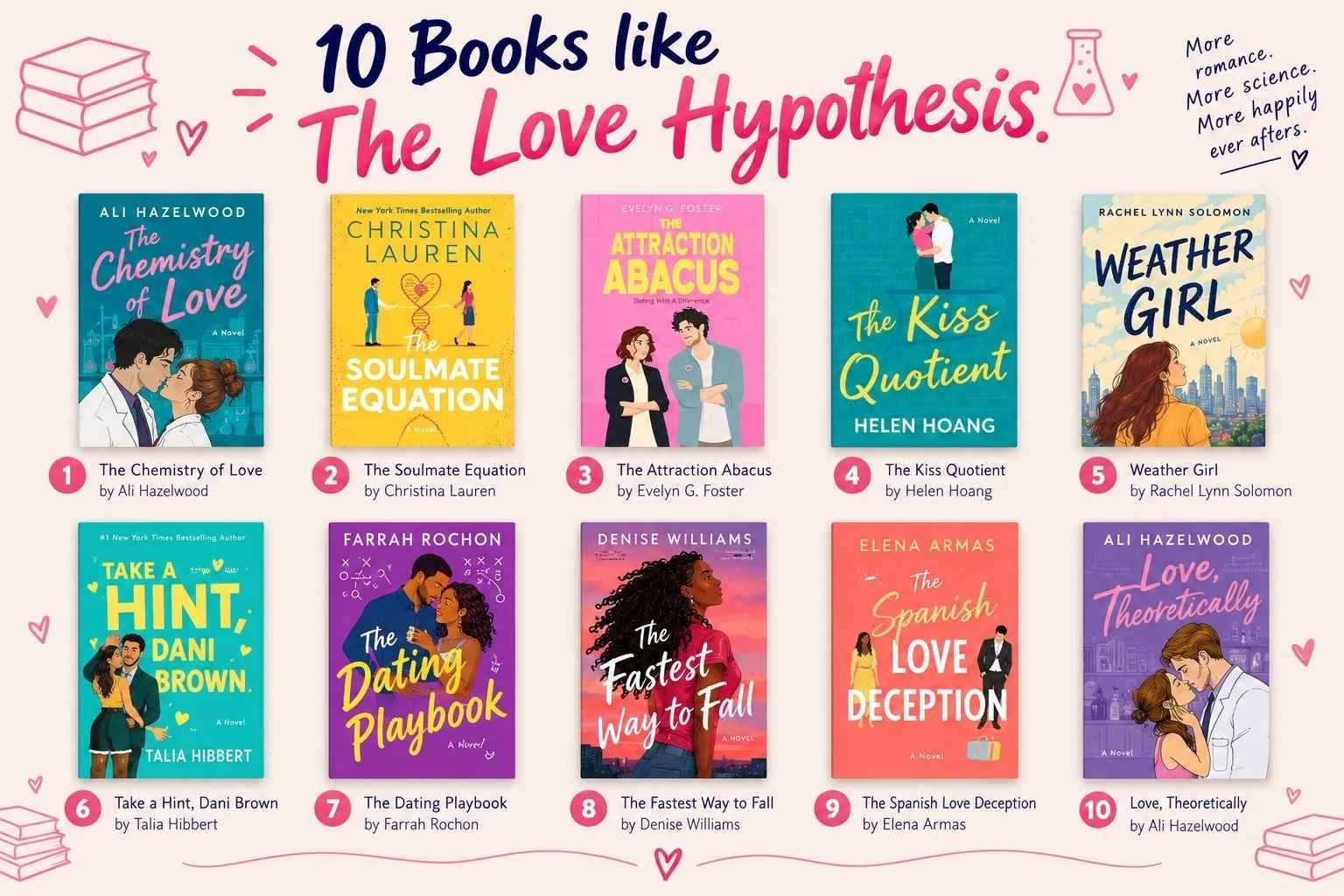
10 Books Like The Love Hypothesis
A fake relationship at an academic conference is all fun and games until someone catches feelings, preferably while holding a clipboard. If Ali Hazelwood’s graduate-school rom-com left you craving awkward brilliance, elite banter and a hero who is quietly, catastrophically gone, these 10 books like The Love Hypothesis should be on your reading list.
What makes books like The Love Hypothesis hit so hard?
It is not just the lab coats. The Love Hypothesis works because Olive and Adam get to be clever, ridiculous and vulnerable in equal measure. There is fake dating with a clear emotional purpose, a woman pursuing a demanding career, a grumpy hero with unexpectedly golden-retriever devotion, and enough academic chaos to make a peer review look romantic.
The books below do not all copy that exact formula. Some go bigger on fake dating, some swap the lecture theatre for a fitness app or a weather station, and some turn the heat level up considerably. What they share is the good stuff: competent women, proper chemistry, emotionally satisfying pay-offs and dialogue you will want to text to your group chat.
1. The Chemistry of Love by Ali Hazelwood
If you want to stay in the Hazelwood cinematic universe, start here. The Chemistry of Love follows Bee Königswasser, a neuroengineer forced to co-lead a major NASA project with Levi Ward, the man she is convinced has disliked her since university. Naturally, science says otherwise.
It has the STEM setting, workplace friction and yearning-heavy romance that Love Hypothesis readers tend to inhale. Bee is funny without being written as a perpetual disaster, while Levi delivers the quiet, intimidating exterior and deeply devoted interior. Expect more enemies-to-lovers energy than fake dating, plus a bigger dose of workplace rivalry.
2. The Soulmate Equation by Christina Lauren
A DNA-based dating company claims it can calculate the perfect match. Jess Davis, a single mum and statistics whizz, is sceptical right up until her supposedly perfect result is revealed to be Dr River Peña, the company’s spectacularly stern founder.
This is a stellar choice for readers who loved the rational-meets-messy-heart tension in The Love Hypothesis. The science is used as a delicious premise rather than a lecture, and the central question lands: what do you do when the numbers say yes but real life is complicated? It is warmer and more family-centred than Hazelwood’s campus romance, with less academic backstabbing and more genuine emotional stakes.
3. The Attraction Abacus by Evelyn G. Foster
The science is hilariously dubious in this one! A dating app that summarises everything about you as a single score. What could go wrong? For a romance that understands dating can feel like a numbers game designed by somebody with a grudge, try The Attraction Abacus. It brings a playful, contemporary lens to the strange calculations of attraction: what we think we want, what we tell our friends we want, and the person who turns up and ruins the whole equation.
When doom-dreaming author, Evelyn Foster, takes an Attraction Abacus flyer from the infuriatingly charming Luke, her carefully unplanned life changes in ways she never expected. Evelyn is soon caught up in fake-dating chaos, questionable matchmaking, and finds herself falling for a man she knows she shouldn’t.
It is a strong option for readers seeking a lighter, low-to-no-spice route to the smart-rom-com payoff. Expect modern dating observations, a sense of fun and the sort of emotional recognition that makes you mutter, unfortunately, relatable. Sometimes the most persuasive chemistry is the kind no formula can explain.
4. The Kiss Quotient by Helen Hoang
Stella Lane is a brilliant econometrician who approaches dating with the same precision she brings to data. When her lack of romantic experience starts to feel like a problem to solve, she hires Michael Phan to teach her. The plan, obviously, becomes much less tidy than a spreadsheet.
Like Olive, Stella is highly capable in her field and less certain when feelings refuse to follow a logical model. This one is tender, funny and intensely character-led, with an autistic heroine whose perspective is handled from lived experience. A quick spice check for your TBR: it is far more open-door than The Love Hypothesis, so save it for a reading mood that welcomes heat alongside heart.
5. Weather Girl by Rachel Lynn Solomon
A gloomy Seattle weather presenter and a relentlessly sunny sports reporter team up to reunite their divorced bosses, hoping it will make their toxic workplace less unbearable. Ari and Russell’s scheme is basically workplace meddling with a side order of adorable.
There is no lab-based research here, but it captures the grown-up career setting and smart romantic momentum that make academic rom-coms so satisfying. Ari is living with depression, Russell is a devoted single dad, and the book makes room for both joy and real-life heaviness without becoming a misery marathon. Choose this one if you want your banter with emotional intelligence attached.
6. Take a Hint, Dani Brown by Talia Hibbert
Dani Brown is a PhD student with a plan for everything, particularly avoiding commitment. Then a viral video of security guard Zafir Ansari carrying her from a fire drill turns them into the internet’s favourite couple. Fake dating follows, because the algorithm loves a ship and apparently so do their hearts.
Dani has Olive’s academic focus and tendency to intellectualise feelings, while Zaf has the kind of considerate hero energy that makes readers stare wistfully into middle distance. The romance is funny, inclusive and properly swoony, with a more explicit heat level than Hazelwood’s debut. It is ideal when you want a heroine who can debate theory all day but still needs help naming the obvious crush in the room.
7. The Dating Playbook by Farrah Rochon
Taylor Powell has worked hard to build her personal-training business, so when a chance to coach former NFL player Jamar Dixon could put her on the map, she cannot afford distractions. Unfortunately, Jamar is charming, determined and very much not part of her carefully organised plan.
This is for readers who enjoy watching ambitious people make room for love without being asked to shrink their dreams. Taylor has the same career-first drive that makes Olive so relatable, and the couple’s support for one another feels earned rather than magically convenient. The setting is sportier, the vibe is sunnier and the friendship around the romance gives it extra bounce.
8. The Fastest Way to Fall by Denise Williams
Britta is a journalist assigned to try a fitness app and write about the experience. Wes is the app’s founder, and he has no idea that the woman he is falling for might review his entire business for a living. That is a meet-cute with a ticking ethical clock.
Readers who liked the professional tension in The Love Hypothesis will enjoy the way this romance lets career ambition complicate attraction. Britta and Wes are both trying to prove themselves, which makes their conflicts feel human rather than manufactured. It is a lovely pick for anyone who wants a contemporary workplace romance where the heroine’s professional voice matters as much as the kiss scene.
9. The Spanish Love Deception by Elena Armas
Catalina Martín needs a date for her sister’s wedding in Spain, mostly to stop her former colleague from thinking she is still hung up on him. Her solution is Aaron Blackford, her tall, silent, allegedly infuriating office nemesis. Fake dating has entered the chat, and it brought one bed at the family home.
This is perhaps the closest match for readers who came for the fake-dating scaffolding and stayed for the hero being secretly all in. It is a longer, more slow-burn read, so your patience will be rewarded with plenty of drawn-out tension, competitive workplace moments and a gloriously committed romantic gesture. Aaron is less brooding professor and more reserved corporate dreamboat, but the emotional flavour is familiar.
10. Love, Theoretically by Ali Hazelwood
Elsie Hannaway is a theoretical physicist with a side hustle as a fake girlfriend, because academia is not exactly known for its generous salaries. When she meets Jack Smith, the experimental physicist who could affect her dream job, professional rivalry and personal attraction become impossible to separate.
This is the obvious final stop if you want the full academic-romance buffet. It has physics, career pressure, a heroine learning to take up space, and a hero who sees more than the polished version she presents to the world. Compared with The Love Hypothesis, it is more directly interested in academic insecurity and institutional nonsense, which only makes the central romance feel more rewarding.
Pick the trope, then trust the chemistry
Want maximum fake-dating fireworks? Go for The Spanish Love Deception or Take a Hint, Dani Brown. Want women in science making very illogical choices about very attractive men? The Chemistry of Love and Love, Theoretically are waiting. And if your ideal happy ending comes with lower heat but no less heart, The Attraction Abacus is a clever next move. Your TBR may not be scientifically sound after this, but it will be extremely well matched.
