
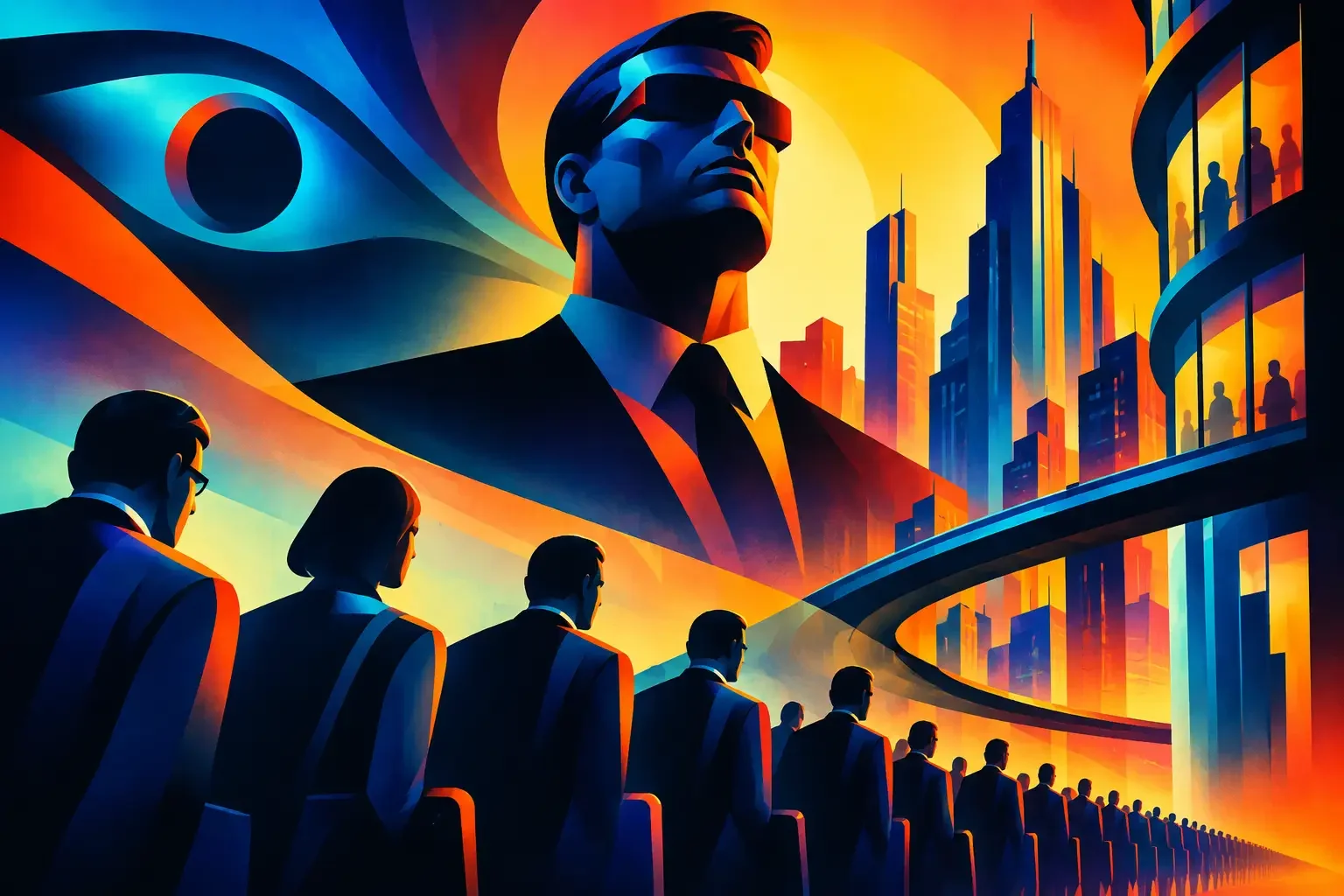
Dystopian corporate fiction
The most frightening villain in dystopian corporate fiction is rarely a cackling tyrant in a cape. It is a pleasant logo, a compulsory wellbeing survey and a company spokesperson assuring you that the new policy is for your benefit. This guide to dystopian corporate fiction is for readers who like their thrillers with a creeping sense that the world has been optimised just a little too far.
Corporate dystopia takes the ordinary machinery of modern life - work, data, convenience, branding, delivery, entertainment - and asks what happens when growth becomes the only moral framework left standing. The result can be a paranoid thriller, a reality-bending puzzle or a near-future nightmare that feels uncomfortably familiar by page three.
What makes corporate dystopia hit so hard?
Classic dystopias often give us a visible state enemy: cameras on every corner, forbidden books, a leader whose portrait is doing rather too much. Corporate fiction shifts the pressure somewhere slipperier. Power is distributed through terms and conditions, reward schemes, algorithmic targets and products people genuinely want.
That distinction matters. A government can demand obedience. A corporation can make obedience feel like a choice, then offer free next-day delivery for choosing correctly.
The best books in the genre understand that the corporation is not scary merely because it is huge. It is scary because it has learned to speak the language of care. It promises efficiency, safety, connection, self-improvement and solutions. Its employees may be kind. Its offices may have excellent coffee. Its app may be genuinely useful. Then the cost of belonging begins to show...
The ingredients of great dystopian corporate fiction
Not every novel featuring a shady business belongs in this corner of speculative fiction. A villainous CEO is not, on their own, a genre. Corporate dystopia works when the company shapes the conditions of reality itself: what people can buy, see, say, remember, earn, desire or believe.
Convenience with a catch
A brilliant corporate dystopia starts with an offer that sounds reasonable. Perhaps a platform can make decisions for you. Perhaps a subscription removes daily stress. Perhaps a workplace programme identifies your ideal role, partner or personality. The promise should be tempting enough that readers understand why people sign up.
This is where the genre earns its chill. If the system is obviously evil from the first page, there is little to interrogate. If it solves a real problem, however, the reader has to sit with an awkward possibility: they might have clicked ‘accept’ too.
The Schelldhardt series. Dystopian corporate fiction. Click on the image above to play trailer. Best with sound.
A system, not just a bad boss
The memorable antagonist is usually the corporate structure rather than one moustache-twirling executive. A senior figure might embody its cruelty, but the real threat lies in incentives, processes and the way ordinary people are encouraged to keep the machine moving.
That makes the moral terrain richer. Employees can be compromised rather than cartoonish. Customers can be complicit and vulnerable at once. Even the protagonist may benefit from the arrangement before recognising its human cost. Nobody gets to remain comfortably innocent, which is rather the point.
Reality under review
Many of the sharpest stories blur the line between authentic experience and managed perception. Surveillance does not need to look like a black van outside the house. It may arrive as personalised entertainment, mood tracking, immersive technology or a feed that knows precisely which fear will keep you scrolling.
This is also why corporate dystopia pairs so well with mystery and thriller plotting. The protagonist is not simply trying to overthrow a giant company. They are trying to work out what is true when every available source has been filtered, branded or paid for.
A human question beneath the high concept
For all the glossy tech, corporate dystopian fiction is rarely just about tech. Its best question is human: what part of yourself would you trade for certainty, comfort or approval? Privacy is one answer. So are freedom, grief, desire, memory and the right to make a gloriously imperfect decision.
That tension gives the genre its emotional charge. A novel can have the cleverest premise in the world, but readers stay for the person who suddenly realises their life has been built around a lie - and must decide whether knowing the truth is worth losing everything else.
How to read the genre without treating it like homework
A guide to dystopian corporate fiction should come with a small warning: this is not a genre that requires you to become the most annoying person at the pub, announcing that every loyalty card is the beginning of totalitarianism. Read it for the pulse of a good story first.
Start by noticing what the fictional corporation sells. The product often reveals the book’s central anxiety. If it sells perfect decisions, the story may be asking whether free will is worth the mess. If it sells eternal connection, expect loneliness to be lurking underneath. If it sells safety, look for the people deemed too inconvenient to protect.
Then watch the language. Corporate jargon is rarely decorative in these novels. Phrases such as ‘community standards’, ‘personal growth’ and ‘frictionless living’ can turn sinister when they conceal coercion. The euphemism is part of the horror. Nobody is fired, perhaps; they are ‘released into new opportunities’. Nobody is monitored; they are ‘supported’.
Finally, pay attention to the protagonist’s compromise. The most satisfying books do not position readers safely outside the system. They show why a sensible person might stay, adapt or accept the promotion. The escape matters more when the cage has decent lighting and dental cover.
Why corporate dystopias feel especially current
These stories are not predictions in the strict sense, and they do not need to be. The genre is strongest when it exaggerates tendencies already visible around us: the monetisation of attention, the outsourcing of decisions, global companies with more reach than some governments, and data collected in exchange for tiny moments of ease.
There is an anti-globalisation current running through much of the genre too, though the best fiction avoids easy answers. A giant corporation can create jobs, connect markets and make useful things widely available. The problem begins when expansion becomes its own justification, when local communities, individual judgement and inconvenient facts are treated as obstacles to scale.
That is why the stories can feel political without becoming lectures. They test the gap between a company’s stated mission and the lives altered by its decisions. They ask who gets included in a frictionless future, who absorbs the friction, and who gets to call the whole arrangement progress.
The thrill is in the resistance
Corporate dystopia can sound relentlessly bleak, but its real pleasure is resistance. Sometimes that means a whistleblower with a stolen file. Sometimes it means a character refusing the role chosen for them by a supposedly perfect system. Sometimes it is as intimate as two people trusting each other’s messy testimony over the official version of events.
For readers who want that blend of philosophical unease and page-turning momentum, Heptagon Books’ The Gap plays in compelling territory: reality is not always what it claims to be, and the corporation at the centre is not interested in staying small. Expect questions about control, choice and the terrifying appeal of a world that says it knows you better than you know yourself.
The next time a fictional company promises to remove every inconvenience from human life, do not run immediately. Read one more chapter. Ask what it wants in return. That is where the really good dystopian corporate fiction begins to bite.
