
Why Debut Romance Authors Feel So Addictive
Debut romance authors
A debut romance can feel like being handed a group-chat screenshot from someone you have known for years. The voice is immediate, the emotional stakes are suspiciously specific, and suddenly you are cancelling plans because two fictional people have failed to communicate for the third chapter in a row. Debut romance authors arrive with the particular energy of writers who have spent a long time noticing how people date, dodge, flirt, self-sabotage and fall in love now.
That does not mean every first novel is perfect. Some are gloriously messy. Some take a chapter or two to find their stride. But when a debut lands, it can feel less like being sold a polished product and more like discovering the book everyone will be talking about six months from now. For readers tired of recommendation lists that keep serving the same five titles in a trench coat, that feeling matters.
What debut romance authors bring to the party
Romance has always been a genre of recognisable pleasures. We want the yearning, the banter, the almost-kiss that makes us put the book down for exactly four seconds, and an ending that earns its happiness. Yet the genre is also constantly changing because dating, friendship, work, family and desire keep changing around it.
New romance writers often arrive close to those changes. They write about the tiny horrors of reading a message twice before replying. They understand that a first date can involve an algorithm, a flat share, a disastrous voice note or a mutual friend who absolutely should not be allowed near the seating plan. Their characters may be navigating situations that older rom-com conventions did not have language for: digital intimacy, burnout, long-distance uncertainty, shifting ideas of partnership, and the difference between privacy and secrecy.
Freshness is not just about putting a dating app on the page, though. A good debut has a point of view. It knows why these two people are drawn together and what makes that attraction inconvenient, funny, frightening or all three. The best new voices do not treat familiar tropes as a shortcut. They ask what fake dating, forced proximity or friends-to-lovers looks like when filtered through a particular sense of humour and a real emotional dilemma.
That is why the first novel buzz is so potent. Readers are not only meeting characters. They are meeting a storyteller's instincts for the first time.
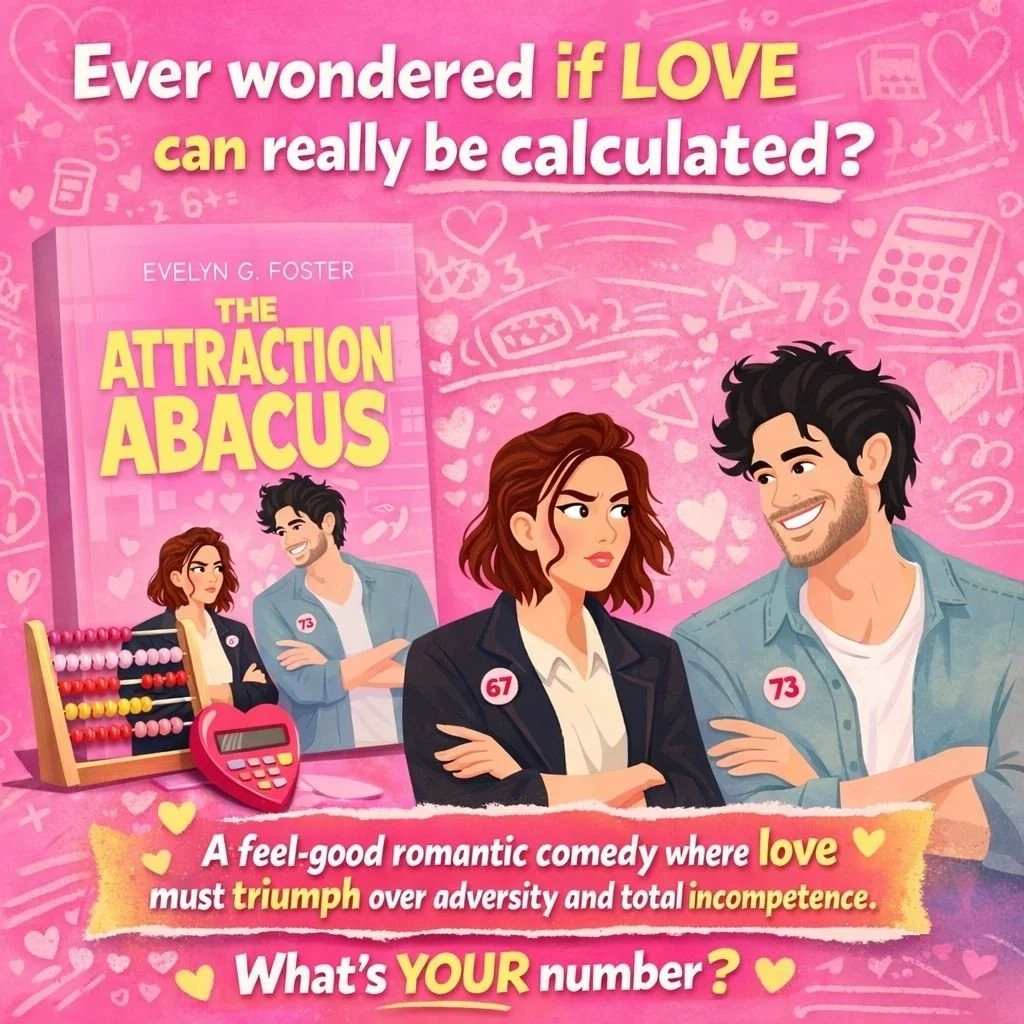
Ad: The Attraction Abacus. Evelyn G. Foster’s romance debut.
The joy of getting in early
There is a small but real thrill in reading an author before the internet turns their name into a personality test. You can recommend the book without sounding as if you have copied a carousel post. You can be the person who says, with entirely reasonable levels of smugness, that you read them before everyone started making fan edits.
More importantly, supporting debut romance authors helps make the genre bigger in ways readers actually feel. Publishing follows attention, and attention makes room for more kinds of love stories: quieter rom-coms, chaotic dating novels, stories centred on friendship alongside romance, mature protagonists, low-spice swoons and books that let sexual tension do some proper heavy lifting without treating explicit scenes as compulsory.
For readers who use spice ratings as a vital part of their book-buying intelligence, debut fiction can be especially rewarding. New authors are not always writing to the narrowest version of what is currently selling. Some offer open-door heat; some prefer closed-door tenderness; some sit in that delicious middle ground where the chemistry is loud but the page stays relatively private. The useful question is not whether a book has enough spice to impress a stranger online. It is whether its approach suits the experience you want.
A low-to-no-spice romance is not automatically twee, just as a high-heat romance is not automatically more romantic. Heat level is a flavour preference, not a moral ranking. Debuts are often where readers find writers who understand that distinction.
A first novel is not a rough draft with a cover
There is a slightly patronising myth that debut authors should be applauded mainly for potential. As if a first book is a polite warm-up before the proper work begins. No, thank you. A debut should be read on its own terms.
Many writers spend years working towards publication. The novel that reaches readers may be their first published book, but it is rarely their first attempt at constructing a scene, breaking a heart or making a joke land at precisely the right moment. It has been edited, reconsidered and fought for. The author may have written several manuscripts before it, each one teaching them something about pace, character and the terrifying power of a well-timed text message.
Still, debut status can signal a particular kind of ambition. A new writer may take chances an established brand would avoid. They might build a rom-com around a niche job, give the love interest an unexpected vulnerability, or allow the protagonist to make choices that are not always immediately likeable. That is not a flaw when it is purposeful. Romance readers do not need leads who are flawless. They need leads whose feelings make sense, even when their decisions make us want to gently confiscate their phone.
How to spot a debut worth your reading time
You do not need to read a book simply because it is a debut. Your TBR is already a towering monument to optimism. But a few clues can help separate a book that matches your mood from one that is merely being loudly promoted.
Start with the emotional promise, not the trope label alone. Enemies-to-lovers can mean sparkling professional rivalry, genuine hostility, or two people behaving with the maturity of a wet tea towel. A blurb that tells you what the characters want, what stands in their way and why they cannot stop thinking about each other will usually reveal more than a string of trope tags.
Then look for specificity. The most memorable romance premises tend to have a detail that makes them feel inhabited: a setting with personality, a job that shapes the plot, a friendship circle that has its own weather system, or a conflict that could only happen to these particular people. Specificity is where relatability begins. Nobody's life is generic, even when they are having a generic bad date.
Reader reviews can help too, especially when they describe tone rather than simply awarding stars. Look for comments about pacing, banter, emotional intensity and heat level. One reader's slow burn is another reader's prolonged administrative delay, so it pays to find people whose preferences resemble yours.
And give yourself permission to be selective. A debut can be clever, heartfelt and clearly well made while still not being your book. Perhaps you need escapism and it offers introspection. Perhaps you wanted a breezy rom-com and it delivers a more serious relationship story. That is not reader failure. It is just the beautiful logistical nightmare of having taste.
The romance conversation needs new voices
Online book culture can make romance seem like a race to identify the next obsession. One week, everyone wants morally grey billionaires. The next, it is cowboys, hockey players, grumpy gardeners or men who communicate competently, the rarest fantasy of all. Trends can be fun, and they help readers find shorthand for what they crave. But they can also flatten books into a checklist.
Debut authors remind us that a romance novel is more than its tropes. It is voice, rhythm, comedy, emotional safety, sexual chemistry, grief, hope and the exact point at which a character realises they have been a complete idiot. Two books can share the same premise and produce entirely different reading experiences.
That is particularly exciting for contemporary romance. The genre is brilliant at holding up a mirror to the way we live, then smudging it with lipstick and giving it a satisfying third-act declaration. A book such as The Attraction Abacus, with its dating-centred premise and rom-com appetite, belongs to a wider reader hunger for love stories that understand modern connection without acting superior about its chaos.
The most shareable debuts are not always the ones with the loudest hook. Often, they are the books that give readers a feeling they cannot quite stop talking about: a line that catches them off guard, a character who feels inconveniently familiar, a romantic gesture that is grand because it is personal rather than expensive. Those are the moments that travel from a reading chair to a group chat, a review, a video and another reader's TBR.
So the next time you see a romance debut being described as fresh, do not take that as empty marketing confetti. Read the sample, inspect the vibe, check whether the heat level and emotional promise suit you, then take a chance if it does. Your next favourite author may be standing at the beginning of their published story, holding a plot twist and a devastatingly good kiss.
