
What Makes a Romcom Book Funny?
What Makes a Romcom Book Funny?
A romcom can have a meet-cute, sparkling chemistry and a cover that practically winks at you from the shelf, then still fail the most basic test - is it actually funny? That is usually the real question behind what makes a romcom book funny. Not whether it is labelled a romantic comedy, but whether it gives you that rare combo of butterflies and a snort-laugh on the same page.
The answer is not simply “good jokes”. In book form, humour has to do more work than it does on screen. There is no actor pulling a face, no soundtrack nudging the moment along, no perfectly timed camera cut. A funny romcom novel has to build laughter out of voice, tension, character flaws, emotional honesty and, crucially, timing. If one of those bits is off, the whole thing can slip from hilarious into try-hard very quickly.
What makes a romcom book funny in the first place?
Usually, it starts with perspective. The funniest romcom books know exactly who is telling the story and why their way of seeing the world is entertaining. That does not mean the main character has to be a stand-up comic. In fact, some of the funniest protagonists are deadly serious about their own chaos. A woman who is convinced she can keep her life under control while accidentally texting the wrong man, hiding under a restaurant table or spiralling over a three-word reply is funny because she believes her behaviour is entirely reasonable.
That gap between self-perception and reality is gold. Readers laugh when a character is just self-aware enough to be endearing, but not so polished that they feel engineered in a lab for maximum relatability. Nobody wants a heroine whose inner monologue sounds like it has been focus-grouped by the internet. The humour has to feel attached to a person, not sprayed on top like glitter.
A strong comic voice also matters more than people sometimes admit. You can hand two writers the exact same plot - fake dating, one flat, forced proximity, enemies with suspiciously flirtatious banter - and one book will zing while the other lands with a polite smile. The difference is nearly always voice. Funny writing has rhythm. It knows when to sharpen a sentence, when to let a scene breathe, and when to stop before the joke explains itself to death.
Funny romcoms need more than banter
Let us defend banter for a moment. Good banter is delightful. It gives chemistry shape. It shows attraction without making every scene a dramatic declaration. It is often the bit readers quote to their friends with a “this is so them” caption.
But banter alone is not what makes a romcom book funny. If every exchange is a quip, the characters can start to sound less like human beings and more like people auditioning for the role of Most Online Person in the Room. The best romcom humour has variety. It moves between sharp dialogue, awkward physical comedy, internal panic, situational absurdity and the quieter kind of joke that comes from knowing exactly how embarrassing it is to be alive.
That variety matters because reading humour is cumulative. A novel needs jokes that hit in different ways. Some moments should be instantly funny. Others should become funnier because you know the character so well that even a tiny reaction says everything. A hero putting the kettle on after a disaster can be funnier than a page of one-liners if the book has done the work.
Character is where the comedy lives
The romcoms readers rave about tend to have one thing in common: the humour grows out of personality. The funny bits are not detachable. You could not lift them into another book and expect them to work the same way.
This is why flaws matter. Not fake flaws, either. Not “she’s too nice” or “he works too hard”. Actual flaws. Petty competitiveness. Overthinking. Catastrophic avoidance. A tendency to interpret one mildly confusing interaction as the end of civilisation. These traits create comic friction, especially in romance, where feelings make everyone slightly less rational than they would like to be.
And the love interest matters just as much. Sometimes the funniest dynamic is opposites attracting, but not always. It can also be two equally chaotic people making each other worse before they make each other better. Or one deeply composed person being slowly dismantled by someone who is all impulse and emotional honesty. Humour thrives on contrast, but the contrast has to reveal something real.
That is also why side characters can make or break a romcom. The best friends, siblings, flatmates and colleagues should not feel like joke delivery systems. They work when they push the main characters into revealing themselves. A blunt best mate who says what everyone else is avoiding is useful. A meddling family member with no sense of privacy is useful. But only if they create pressure, not just noise.
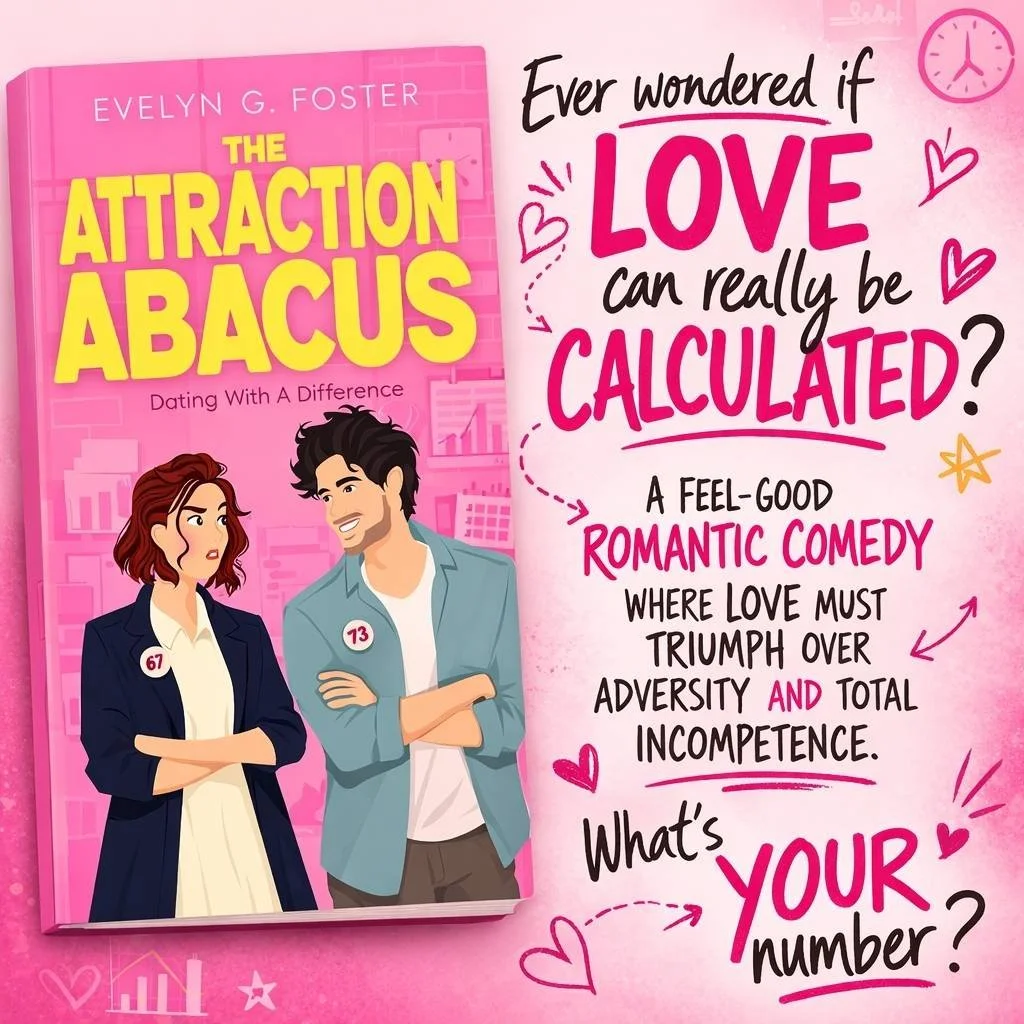
Ad: The Attraction Abacus. A laugh-out-loud modern rom-com. Click the image to find out more!
Timing on the page is its own kind of magic
Film gets a lot of credit for comic timing, but prose timing is elite when it is done well. A funny romcom knows how to place information for maximum effect. It knows when to cut a paragraph short, when to let a character dig their own grave in dialogue, and when a single understated sentence will land harder than an elaborate set-up.
This is one reason pacing matters so much. If a book is too frantic, none of the jokes have room to breathe. If it is too slow, even clever humour starts to feel laboured. Romantic comedy needs movement. You want escalation. One awkward encounter becomes an accidental lie, which becomes a fake date, which becomes an emotional complication nobody was prepared for. The comedy often comes from watching small messes snowball into bigger ones.
There is also the matter of restraint. Funny books trust the reader. They do not pause after every joke as if waiting for applause. Over-explaining is a comedy killer. So is telling readers that something is hilarious instead of making it hilarious.
The best romcom humour has emotional stakes
This is where some books really separate themselves. Being funny is great. Being funny while making the reader care is much harder.
A romcom novel becomes genuinely memorable when the comedy is tied to vulnerability. The heroine is not just flustered in front of the hero because that is a genre requirement. She is flustered because being seen is terrifying. The hero is not just dry and grumpy for contrast. He is guarded for a reason, and his deadpan reactions become funnier because they sit next to real feeling.
In other words, humour lands better when it has something to bounce off. Embarrassment, longing, grief, insecurity, hope - all of it can sharpen a funny scene. That balance is the secret sauce. Too much comedy with no emotional weight and the book feels frothy in a forgettable way. Too much angst and barely any wit, and it stops feeling like a romcom at all.
It is a delicate mix, which is why reader taste varies so much. One person’s perfect romcom is another person’s “this was more romance than comedy” review. Heat level changes that balance too. A low-spice or no-spice romcom often relies even more heavily on dialogue, tension and comic set-pieces. A steamier one may use sexual tension as part of the humour. Neither approach is automatically better. It depends on the tone the book is aiming for.
What makes a romcom book funny for modern readers?
Now for the slightly chaotic truth: humour dates fast. A joke that felt fresh five years ago can now feel like it was thawed out from an old group chat. Modern romcom readers are especially alert to this. They want books that feel current without sounding desperate to prove they know what an algorithm is.
That means funny contemporary romcoms often work best when they understand modern social behaviour rather than just name-dropping apps or trends. The horror of misreading a text. The performance of pretending not to care. The niche humiliation of seeing someone at the exact wrong moment. The way dating can make otherwise competent adults behave like detectives with abandonment issues. That is recognisable material.
This is where publishers with a sharp eye for reader culture, like Heptagon Books, tend to stand out. The strongest romcoms do not simply copy what is popular on BookTok. They understand why readers are talking about certain books in the first place. Usually, it is because the humour feels emotionally true, not because every chapter is trying to become a quote graphic.
Why some romcom books are charming but not laugh-out-loud
And to be fair, not every romcom needs to be wall-to-wall comedy. Some are more accurately warm, charming, lightly funny. That can still be a very satisfying read. The problem comes when a book is marketed as hilarious and delivers one amusing line every fifty pages.
If readers say a romcom was “cute” but not especially funny, it often means the chemistry worked but the comic engine did not. Maybe the voice was too flat. Maybe the situations were predictable. Maybe the characters were so polished that they never became ridiculous in the deliciously human way romcoms need.
Funny usually requires risk. A bit of mess. A willingness to let characters be cringe, dramatic, stubborn, needy or accidentally feral. Romcoms are at their best when they understand that love is not just swoony. It is absurd. Deeply, specifically, gloriously absurd.
And that is probably the simplest answer to what makes a romcom book funny. It sees the madness in wanting to be loved, then turns that madness into something charming instead of cruel. If a book can make you laugh at the chaos of romance while still rooting hard for the people inside it, that is not just funny. That is the good stuff.
