
12 Best Grounded Sci-Fi Novels That Feel Real
Grounded Sci-Fi Novels
A spaceship is fun. A spaceship that feels like it could break down on the M25 of the solar system is better. The best grounded sci-fi novels take one recognisable part of modern life - work, climate anxiety, dating, surveillance, corporate power, grief - and nudge it just far enough for you to feel the chill.
This is sci-fi for readers who enjoy big ideas but do not require a glossary of made-up minerals before page 30. Think less laser-gun wallpaper, more: wait, could this actually happen? Some are scientifically meticulous; others are emotionally plausible rather than technically exact. All of them understand that the scariest future is usually the one that looks suspiciously like Tuesday.
What makes sci-fi feel grounded?
Grounded science fiction is not one neat subgenre with a clipboard and a strict dress code. It is a reading experience. The world may contain clones, artificial intelligence or a suddenly altered climate, but the human behaviour tracks: people worry about their children, compromise at work, fall in love inconveniently and make terrible decisions when a powerful institution offers an easy answer.
The best examples also give the speculative element consequences. A new technology does not merely exist to look cool. It reshapes who has power, who gets left behind and what people are prepared to call progress. That is why these books land so hard with readers who like The Matrix, Inception or The Truman Show: the premise is wild, but the emotional logic is horribly familiar.
12 best grounded sci-fi novels for your TBR
Never Let Me Go by Kazuo Ishiguro
Ishiguro begins with an English boarding-school atmosphere so calm and ordinary that its deeper horror arrives almost politely. As Kathy remembers her childhood with Ruth and Tommy, the truth about their lives emerges in fragments. It is restrained, melancholy and devastatingly human - proof that a quiet voice can be more unnerving than a thousand exploding planets.
The Martian by Andy Weir
If your ideal survival thriller includes problem-solving, gallows humour and a man refusing to die because he has not finished the maths, meet Mark Watney. Stranded on Mars, he has to grow food, repair equipment and improvise his way through a sequence of increasingly rude setbacks. The science is front and centre, but the real pleasure is watching competence become a survival skill.
The Gap by Steve Frogley
For readers drawn to stories where reality has a loose thread, The Gap brings speculative unease close to home. Its interest is not shiny technology for technology's sake, but the pressure placed on ordinary judgement when the systems around you may not be telling the whole truth. If you enjoy a thriller that makes you question the rules while keeping the human stakes in view, put this on the pile.
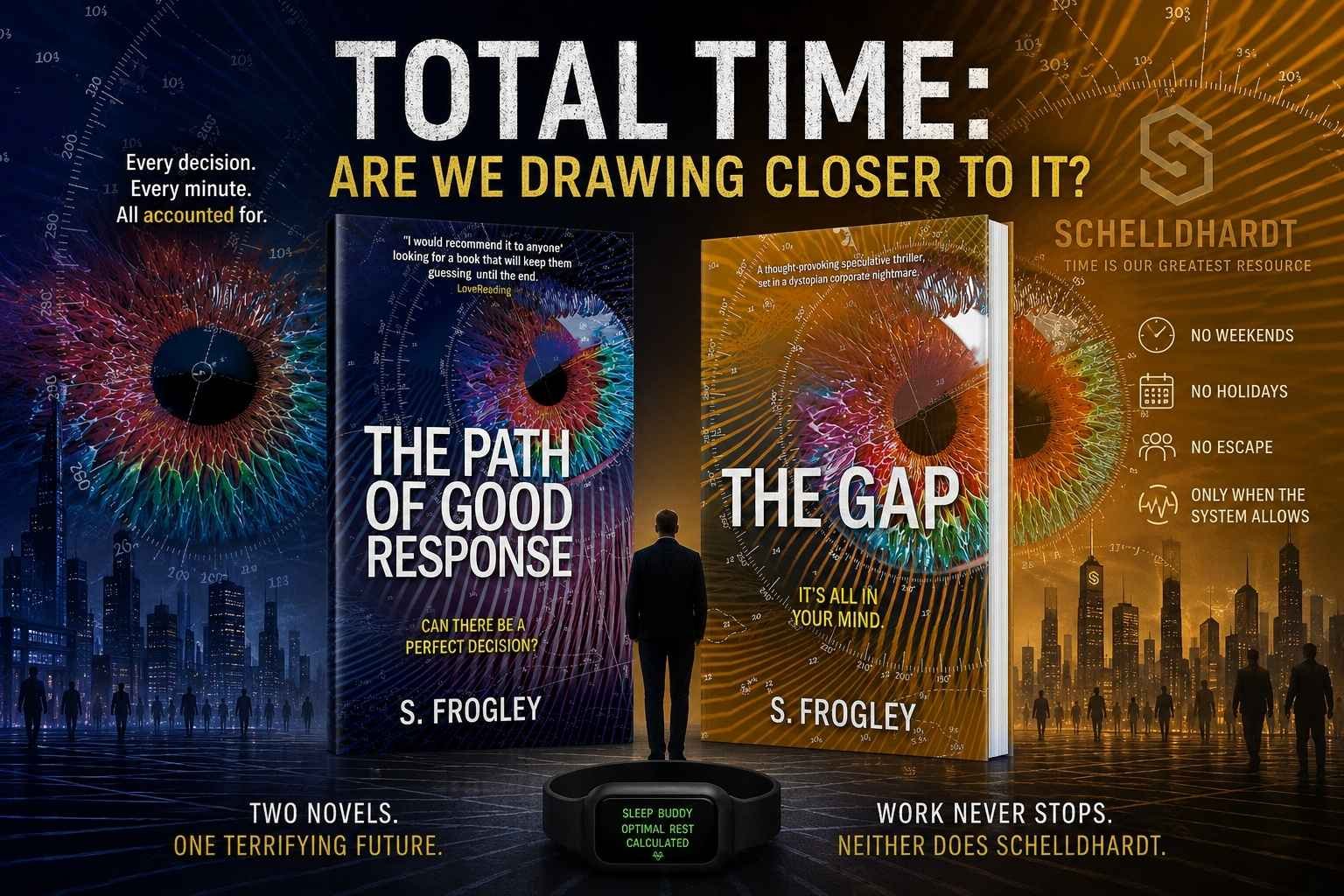
The Schelldhardt Series. Terrifying and plausible.
Klara and the Sun by Kazuo Ishiguro
An Artificial Friend observes a family and the social world around her with touching precision. The technology is deliberately not over-explained, which is exactly why it works: this future has simply become normal to the people living in it. Beneath Klara's innocence sits a sharp question about love, replacement and whether being useful is the same thing as being valued.
The Power by Naomi Alderman
What if teenage girls developed the ability to deliver an electric shock? Alderman follows the political, religious and personal fallout as the global balance of power tilts. It is provocative, occasionally uncomfortable and very much designed to start an argument in the group chat. The cleverness lies in how quickly a single biological shift exposes systems we already recognise.
The Ministry for the Future by Kim Stanley Robinson
This is climate fiction with its sleeves rolled up. Robinson imagines the institutions, financial mechanisms, disasters and compromises involved in trying to prevent climate collapse, beginning with a devastating heatwave in India. It can be dense, and it occasionally reads more like a policy briefing with a pulse than a conventional thriller. But for readers who want plausible stakes rather than vague apocalypse vibes, it is electrifying.
Station Eleven by Emily St. John Mandel
A pandemic has altered the world, but Mandel is less interested in body counts than in what people carry forward. Her characters move between the days before the outbreak and the years after it, connected by art, memory and one fragile travelling theatre company. It is tender rather than grim, with a clear-eyed belief that survival without culture is only half a life.
The Circle by Dave Eggers
The future in this corporate dystopia is barely a future at all. Mae lands a dream job at a glossy tech company that wants to make every interaction visible, measurable and shareable. The satire can be broad, so it will not suit readers looking for subtlety at every turn. Still, its central nightmare - privacy being repackaged as a moral failure - has only become more recognisable.
Dark Matter by Blake Crouch
Jason Dessen is abducted and wakes in a life that appears to be his, except it is not. Crouch turns multiverse theory into a propulsive, emotionally direct thriller about the choices that make a person who they are. The pace is aggressively bingeable, with chapters that practically dare you to say, “Just one more.” Ideal for readers who want existential dread with a plot engine.
The Children of Men by P. D. James
In a near-future England where no children have been born for decades, Theo Faron has learned to live without hope. Then a pregnancy changes everything. James gives the premise political weight without losing sight of its intimate grief: a childless society is not merely demographically unstable, but spiritually exhausted. It is a lean, chilling book with no interest in offering easy comfort.
The Mountain in the Sea by Ray Nayler
An eco-thriller with real intellectual teeth, this novel follows a scientist studying an astonishingly intelligent octopus species while humans exploit both technology and one another. It asks what consciousness looks like when it does not resemble ours, and whether humanity has earned the right to meet another mind. The ideas are big, but the tension is immediate - sea, secrets and corporations behaving with maximum corporate menace.
Oryx and Crake by Margaret Atwood
Atwood's future is stuffed with designer biology, private compounds and consumer culture taken to its grotesque endpoint. Snowman appears to be one of the last humans alive, remembering the friendship and rivalry that helped create his ruined world. It is funny in a bleak, teeth-bared way, and frightening because its corporate excesses feel less like fantasy than an advert campaign that got wildly out of hand.
Choose your flavour of plausible dread
Start with The Martian or Dark Matter if you want pace, jeopardy and a premise you can pitch to a friend before they finish their coffee. Choose Never Let Me Go, Klara and the Sun or Station Eleven if your preference is a slower emotional ambush - the sort of book that leaves you staring at the kettle afterwards.
For corporate paranoia and social systems gone sideways, The Circle, Oryx and Crake and The Power are the sharpest picks. If climate, ecology and the future of the species are already occupying too much of your brain, The Ministry for the Future and The Mountain in the Sea offer different kinds of reckoning. One is systemic and urgent; the other is strange, aquatic and quietly profound.
The right grounded sci-fi novel is not necessarily the one with the most accurate equations. It is the one that makes a strange possibility feel personal - then leaves you looking at your phone, your workplace or the weather forecast with fresh suspicion.
