
Romantic Comedy Book Review: What Matters

Romantic Comedy Book Review: What Matters
One bad rom-com read can send you into a full book slump. You wanted fizz, flirting and at least one scene that made you grin at the page like a menace on public transport. Instead, you got flat jokes, forced chemistry and a couple who seemed better suited to separate WhatsApp groups. That is exactly why a good romantic comedy book review matters - not just to say whether a book is nice, but to tell you whether it actually delivers the very specific magic this genre promises.
Romantic comedy is one of the most deceptively hard genres to get right. Readers do not just want romance, and they do not just want comedy. They want emotional payoff with timing. They want crackling dialogue, believable attraction and enough self-awareness to keep the whole thing from tipping into cringe. The bar is not low simply because the cover is pastel.
What a romantic comedy book review should actually tell you
The most useful reviews do more than hand out stars and say the main character was relatable. A proper romantic comedy book review should answer the questions readers are already asking in their heads. Is it genuinely funny, or does it just have a quirky premise? Is the romance convincing, or are we being asked to believe in soulmates because they shared one sarcastic exchange near a coffee machine?
Tone is everything here. Some rom-coms are feather-light and chaos-fuelled, built around misunderstandings, disastrous dates and a heroine whose internal monologue deserves its own fan club. Others lean more contemporary romance, with humour layered over grief, career panic or the emotional wreckage of modern dating. Neither approach is wrong, but the reading experience is wildly different. A review that cannot pin down the tone is not doing its job.
The same goes for heat level. Readers are not being fussy when they want clarity on spice. They are trying to avoid that oddly common mismatch where a book gets pitched as a sweet rom-com and then suddenly everyone is against a kitchen counter by chapter six. Equally, some readers want longing, yearning and tension so intense it could power the National Grid, and they will feel cheated if the romance stays strictly closed-door. A good review should be honest about where a book sits on that scale.
The best rom-com reviews pay attention to chemistry
Chemistry is not just two attractive people standing near each other while the blurb insists they are obsessed. It lives in rhythm, subtext and the little moments a writer chooses to emphasise. Does the banter feel easy? Do the characters notice specific things about each other? When they clash, does it sharpen the tension or just make one of them irritating?
This is where plenty of books wobble. A premise can be catnip - fake dating, enemies to lovers, workplace chaos, one bed, accidental plus-one, all the classics - but if the chemistry is not there, the trope cannot save it. Readers know this instinctively. We have all finished a book thinking, lovely concept, shame about the actual couple.
A sharp review should look at whether the connection evolves in a satisfying way. Does attraction deepen into affection? Do the leads earn their ending? If a book wants us to root for the couple, it needs more than good bone structure and a few flirtatious texts.
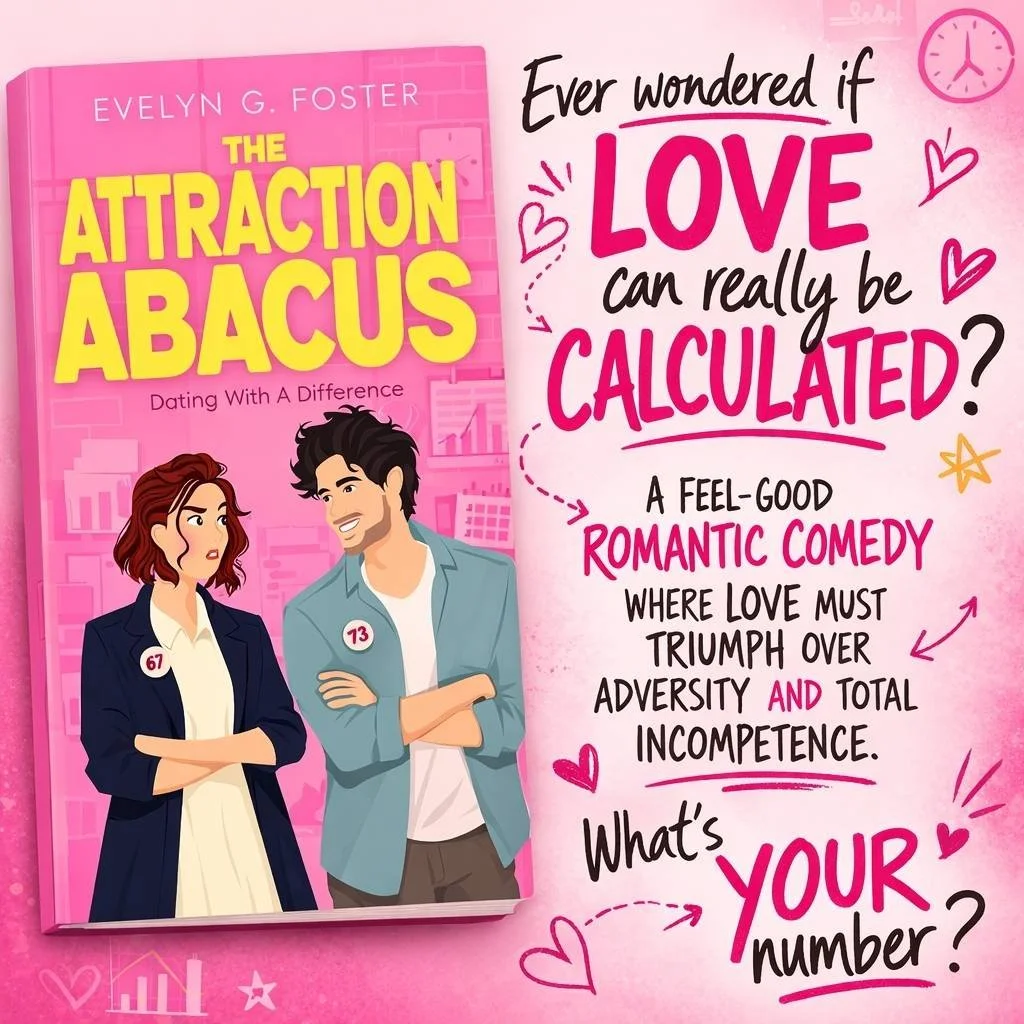
Ad: The Attraction Abacus. A quirky, workplace rom-com
Humour is subjective, but not infinitely so
Yes, comedy is personal. One reader’s hilarious disaster date is another reader’s second-hand embarrassment nightmare. Still, there is a difference between humour that lands and humour that feels like it is trying very hard to become a screenshot on Bookstagram.
When reviewing a rom-com, it helps to ask what kind of funny the book is aiming for. Is it dry and witty? Broad and chaotic? Awkward in a Bridget Jones sort of way? Sharply observant about dating culture, couple culture and the strange theatre of app-based romance? Specificity matters because humour without context tells readers almost nothing.
It is also fair to say when the jokes undercut the emotional stakes. A rom-com can absolutely be light, but if every vulnerable moment gets swerved with a gag, the romance may never gather real depth. On the other hand, if the book forgets to be funny for long stretches, readers who came for sparkle may start wondering who replaced their rom-com with a therapy session.
A romantic comedy book review should clock the dating realism
Contemporary rom-com readers are not necessarily asking for realism in the strict literary sense. No one is demanding spreadsheets of rental costs or exact train timetables, unless that is somehow the kink of the week. But they do want emotional plausibility, especially in stories shaped by modern dating.
That means reviews should notice whether the book understands how people actually connect now. Does it capture the low-grade absurdity of dating apps? The mixed signals, the overthinking, the group chat debriefs, the way one decent voice note can alter your entire mood? Books that get this right feel current without trying too hard. Books that get it wrong often sound as if someone read three tweets about online dating and declared the research complete.
This is part of why relationship-centred fiction has become such a talkable space. Readers are not just looking for fantasy. They are looking for recognition. They want to feel seen in the mess as well as the fantasy of finding someone lovely in it.
Tropes help, but execution decides everything
Rom-com readers are famously trope-aware. That is not a weakness. It is part of the fun. Spotting fake dating in the wild or clocking an enemies-to-lovers setup by page twelve is less about surprise and more about anticipation. We know the beats. We are here to see whether the author can make them feel fresh.
A smart review should talk about trope execution, not just trope presence. Saying a book has forced proximity tells us very little. Was it deliciously tense or wildly contrived? Did the misunderstanding create momentum or just make everyone seem incapable of basic conversation? Did the third-act breakup feel emotionally earned, or was it wheeled in because the genre handbook said there must be one?
This is often where standout rom-coms separate themselves from forgettable ones. The best books know the rules well enough to play with them. They lean into what readers love while still giving the relationship a shape and texture of its own.
Character voice can make or break the whole thing
If the main character spends 300 pages being painfully quirky in a laboratory setting of manufactured mishaps, readers will notice. Quickly. Romantic comedy lives and dies on voice because so much of the pleasure comes from spending time inside a character’s worldview.
That voice does not need to be universally likeable, but it does need to feel deliberate. Maybe the heroine is over-analytical, emotionally avoidant and one minor inconvenience away from spiralling. Fine. Maybe the hero is charming but defensive, funny but impossible to pin down. Also fine. The issue is not flaw. The issue is whether the writing turns flaw into personality rather than repetition.
Reviews should also consider the supporting cast. In a great rom-com, friends, exes, colleagues and family members do real work. They add pressure, perspective and comedy. In a weaker one, they exist solely to say things like, you clearly fancy him, which is not a role so much as a high-vis plot device.
Why reader expectations matter more than star ratings
A three-star rom-com can be perfect for the right reader, and a five-star one can leave someone cold. That is not a cop-out. It is just how taste works in a genre built on tone, fantasy and emotional preference.
The best reviews understand this and review for fit as much as quality. If a book is low-spice, high-banter and emotionally warm, say that clearly. If it is heavier than the cover suggests, say that too. If it offers excellent romantic tension but very little laugh-out-loud comedy, readers deserve that distinction.
This is especially true now, when recommendation culture moves at frightening speed and half the internet is busy declaring every enjoyable novel the book of the year. A useful review cuts through the noise. It does not perform enthusiasm for the algorithm. It gives readers enough texture to decide whether a book suits their mood.
For publishers with a finger on modern reader conversations - and yes, that includes independent houses like Heptagon Books - this kind of clarity matters. Readers are not short on options. They are short on trustworthy signals.
The rom-com books worth talking about usually know their own lane
The most satisfying romantic comedies tend to understand exactly what they are offering. They are not embarrassed to be funny, romantic, emotionally open or gloriously tropey. They do not mistake cynicism for sophistication. They know that lightness can still be smart, and that entertainment is not a lesser art form just because it comes with kissing.
A strong review should meet the book on those terms. Not every rom-com needs to be profound, but it should know how to deliver on its own promise. If it sells banter, the banter had better sparkle. If it sells yearning, the tension should be painful in the best way. If it sells low-spice sweetness, readers should close the book feeling adored rather than short-changed.
That is the real point of reviewing romantic comedy well. It is not about proving taste. It is about helping readers find the stories that will actually hit the spot - the ones with the right mix of charm, chemistry and emotional payoff for whatever mood they are in. And honestly, in an era of endless recommendations and suspiciously enthusiastic blurbs, that kind of honesty is its own love language.
